Posted on

A Friction Jeweling How-to and PDF for Vintage Hamilton Watches

What’s Friction Jeweling any way?

In 1924, Hamilton took credit for the first improvement in jeweling since Nicolas Facio patented the use of jewels in watches in 1704. Hamilton called their system “improved jeweling”. Now, the Swiss claim they invented friction jeweling, but they haven’t produced any names or dates to substantiate their claim that I can find.

Let’s look at what Hamilton said. First, they claimed that as a  result of years of experimentation and research, that they came up with the “Hamilton Improved Friction Jeweling” method.

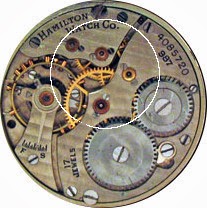
They then demonstrated it on the 989 18/0 watch movement.

While difficult to decipher from the image above, the 989 did not have bezel rings holding their jewels in place. You can see the difference in the two types of jeweling methods in the  photos below.
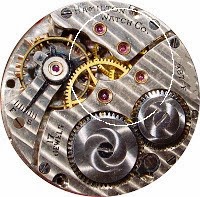
Hamilton released its first 987 caliber wristwatch movement with beveled edged jewels.This method held the jewels in with a screw-held ring. If you take a close look at the image on the left, then you can see two small screws holding a ring over each jewel. Hamilton released the next version of the 987 with friction jewels after the 989 proved it worked.

Little information exists on who actually manufactured the first friction jewels. Since Hamilton bought their jewels from Swiss companies, we can guess that the jewels came from Switzerland. Regardess, design and manufacturing techniques for watch jewels improved around the time Hamilton produced the 989 and subsequently. the 987E.  Hamilton began using jewels able to hold their position with friction alone, which cut down on time and effort to manufacture and service movements.

(You can download a copy of this post. See link at end)

In this small post, we can look at how K&D and Moseley recommended replacing friction jewels.

The method for replacing a broken or dysfunctional jewel involves:

  1. Measuring
  2. Knocking out the old jewel and
  3. Setting a new jewel.

Once you discover the simplicity of friction jeweling, anxiety about it will fade. Let’s go through the steps so we can move forward in our understanding of watch maintenance and repair.

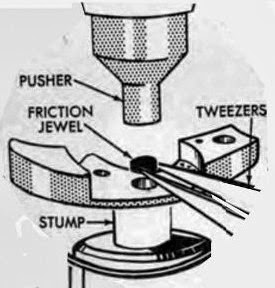
1. Select a jeweling stump with a hole larger than the jewel needing replacement. Place the stump in the die plate of your staking tool and center.
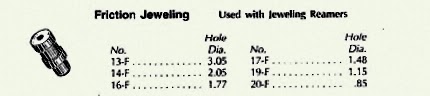
2.      Select a pusher smaller than the jewel needing replacement. Place the pusher in its holder and secure it in the frame sleeve.
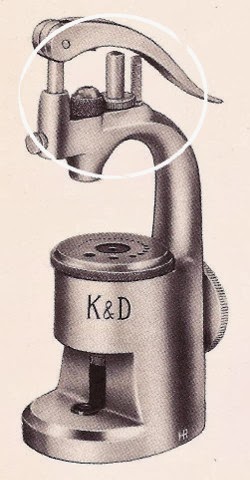
Staking Frame with Micrometer

3. With the exception of Balance Jewels, use the pusher to adjust the micrometer. For example, place a watch bridge on the stump facing up. Rest the pusher on the old jewel and adjust your micrometer to limit the movement of the pusher. Jot down the setting on a piece of paper and use it when setting the depth for the replacement jewel.

4. Lower the micrometer stop and press on the old jewel to remove it.

5.  If you have friction type jewel with an undamaged hole, skip the next two steps.

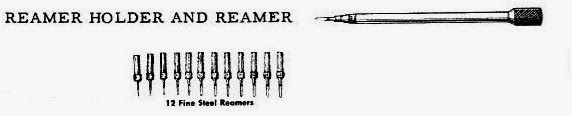
6. If you need to refinish the hole, pick out one of the reamers. Make sure it is large than the existing hole.

7. You can now ream the jewel hole for your replacement jewel.

8. Again, use the holder for the reamer and place it through the staking frame’s sleeve.

9. Don’t let the reamer go further than a millimeter into the hole.

10. Turn it to create a smooth and appropriate size hole.

11. Use a cone miller to remove any burrs from the edges of the hole.

12.  Now, you can place the jewel in the reamed out hole. Make sure the oil cup is face down.

13.  Use the pusher from step 2. Set the micrometer as you did in step 3.

14.  Rest the pusher on the new jewel and then press down the jeweling lever on your frame. The micrometer will stop it from pushing the jewel past the proper fit.

15.  Check to see if the watch part using the hole has a proper end-shake. You’ll need to rely on whatever literature exists for your watch.
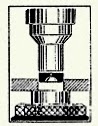

16.  If you have to reset the jewel, adjust the micrometer stop and reset the jewel.

17.  If friction type settings are loose in the plates or bridges of your watch, you’ll need to tighten it by closing the hole.

18.  Use a taper mouth closing punch. (K&D punches 31 through 38A. Moseley  E1 through E9).

19.  A taper mouth closing punch draws soft metal in and reduced the size of the a jewel hole.

20.  Select a punch slightly smaller than the setting.

21.  Place the setting on a flat face stump, center it and tap the punch. You will see a groove that will help create a tight fit. Proceed at a slow pace as this tightening process will incorporate trial and error.

I wrote this as a high level view of the jeweling process. The entire scope of jeweling is a body of knowledge in itself. Never-the-less, I found this information helpful. It took the mystery out of the process for me.

You may download a PDF of this post and/or for an extensive treatise by J Bulova click here .

Respectfully submitted

Posted on

Repairing Hamilton Watches: K&D’s 1910 Booklet on Staking Sets and How to Use Them

If you have followed this website you know that the focus has changed. The transition began before Christmas 2013.  I’ve gone from showcasing Hamilton wristwatches for identification to a broader mission.

The emphasis on Hamilton Watch Company remains, and will encompass tracking of wristwatches and pocket watches. Economic conditions affect the price of Hamilton products. I don’t see this as a simple pause. I feel it’s important to share information about the buying and selling of watches.

When people say that time marches on – I don’t see time marching in the streets like a college band or a military parade. Let’s just say, people have trouble finding parts for old watches. Even the popular watches sold in jewelry stores after World War II are one-half a century from their date of manufacture. No one makes parts for old watches.

I collect watches 80-120 years old. You won’t find many parts for those. I’ll keep an eye on suppliers and let you know about those.

Hamilton provided very little documentation for the repair and service of their watches before World War II. The company expected a trained and qualified watchmaker to know what to do. Watchmakers apprenticed.

You will also find documentation to help you service and repair older Hamilton watches.

I have also ventured into finding and identifying vintage watch tools. Finding information on those strange looking creatures venturing out of the closets of deceased watchmakers requires unending research. In the process, I have found documentation on the history of companies that made the tools we all want to use and buy (or sell).

For those of you wanting more information about Hamilton watches from a micro point of view, I follow a blog that should give you what you want.

HandyDan’s website known as the Hamilton Chronicles  provides a rich source of information on Hamilton Wristwatches in particular. I recommend you make it a part of your reading and research.

Back to this blog’s focus:

I wrote the following information in an earlier post:

Opinions vary about what’s vintage and what’s old. If you look on eBay, they label watches made from 1920 to 1970 as vintage. That’s a wide range. I see a huge difference between a 1929 Cushion and a 1965 Stainless Steal Automatic.

In my opinion, when Hamilton stopped putting 987 movements in their best cases the vintage era ended. Afterwards, used Hamilton watches became just old watches. Some call them “mid-century” and “preowned“, but to me, they’re just plain old used watches. Nothing differentiated them from Bulova, Caravel, Waltham, Elgin and so forth. American domination of the watch business faded into the distance after World War II.

Who made the decision to put the best American wristwatch movements ever made in 10K gold filled cheap (not Wadsworth) cases?

When the company decided to offer “popular priced” watches, the decline began. Looking back, you have to wonder who made the decision to put the best American wristwatch movements ever made in 10K gold filled cases? Frankly, I think Hamilton cheapened their line. They remind me of Elgins.

The movement saved Hamilton when the US entered World War II. The Military selected the Hamilton’s 987A and 987S for staff, pilots, officers and infantry.

The vintage era ended about 1939. The next year began the military era. After the war, you suddenly had the copycat era, which was short lived. Next came the Swiss era and the beginning of the end of American made watches.

I have little interest in watches released by Hamilton after 1936. I find the 987A movement a draw, but the overall watches are a cheap version of wristwatches from a great era. I think you can blame that on the Great Depression and lousy management.
As we progress in the change of this blog’s vision, I’m providing materials to help you work on vintage watches.
The following download contains a book about how to use staking sets. It’s the second document of this kind I have posted. If you have an interest in a similar treatise, check the download on an earlier post
I believe the second version of the book, downloadable here will also help you find your way through the world of staking tools and how they can help you work on Hamilton movements. You’ll see a more professional book on staking tools and their use from me in the days and weeks to come.


Posted on

Vintage Watch Tool Identification Guide Download

(The link to download the guide exists at the bottom of the page).

One of my friends said, “I can do anything with a staking set and a lathe, but I prefer specialized tools.”

I agree with him. I look for tools that can help me do a better job at watchmaking. Sometimes those specialized tools do not get the job done and sometimes they do. I have found the pre-owned vintage tools in most cases superior to new ones. That’s not always the case, but using generalities often  gets me in trouble so I won’t say every time.

When I attended Horology School in Paris, Texas at the Institute of Jewelry and Horology, I found a world of surprises. The biggest, perhaps, involved the tools the school provided. Most came from the period of 1930 through 1959. Why? The instructor explained that before digital and crystal watches changed the landscape, approximately 30-60,000 watchmakers worked in the United States. Today, the profession employs about 2500.


The bulk of interest in vintage watches and tools comes from amateurs, self-taught watchmakers and hobbyists. Depending on the progression of the non-certified watchmaker, certain tools become essential. For example, I never thought I would want a lathe. I left horology school when I faced a boring semester of lathe work. I didn’t want to spend $5000 to sit on a lathe.

Today, I need to know how to polish and burnish pivots. My area of interest in watches requires more work than changing parts. Often I have to retrofit them or find parts watches and make changes in wheels, balance staffs and so forth.
I browse eBay for vintage tools. I buy new ones from Esslinger, when possible. On eBay, I’ve gone through the school of hard knocks. For example, a seller listed a balance screw holder as a pin vise. When I asked how she identified it, the seller wrote, “my watch person” said it was a pin vice. I asked her about her “watch person” and it was the widow of a watchmaker.
The active watchmakers of the pre-quartz days have died off in recent years. If you shop on eBay, you will notice hundreds of vintage watches and tools flooding a once tight market. Watchmakers’ estates abound and so do “estate and garage sale” dealers. For the most part, estate buyers haven’t a clue what they have. You will see an item worth about $10 listed for $200. I look for the $200 items someone listed for ten dollars that says “nice watchmakers tool”. I actually find some.
This booklet will help you identify vintage watch tools. It’s from an old catalog dated 1953. I have a second one from Lindstrom dated 1951 and you’ll find it on my site too.
The point of all this? To help you and me enjoy our work and get it done with the best tools possible.

Respectfully submitted