Introduction: A Watch That Defies Expectations
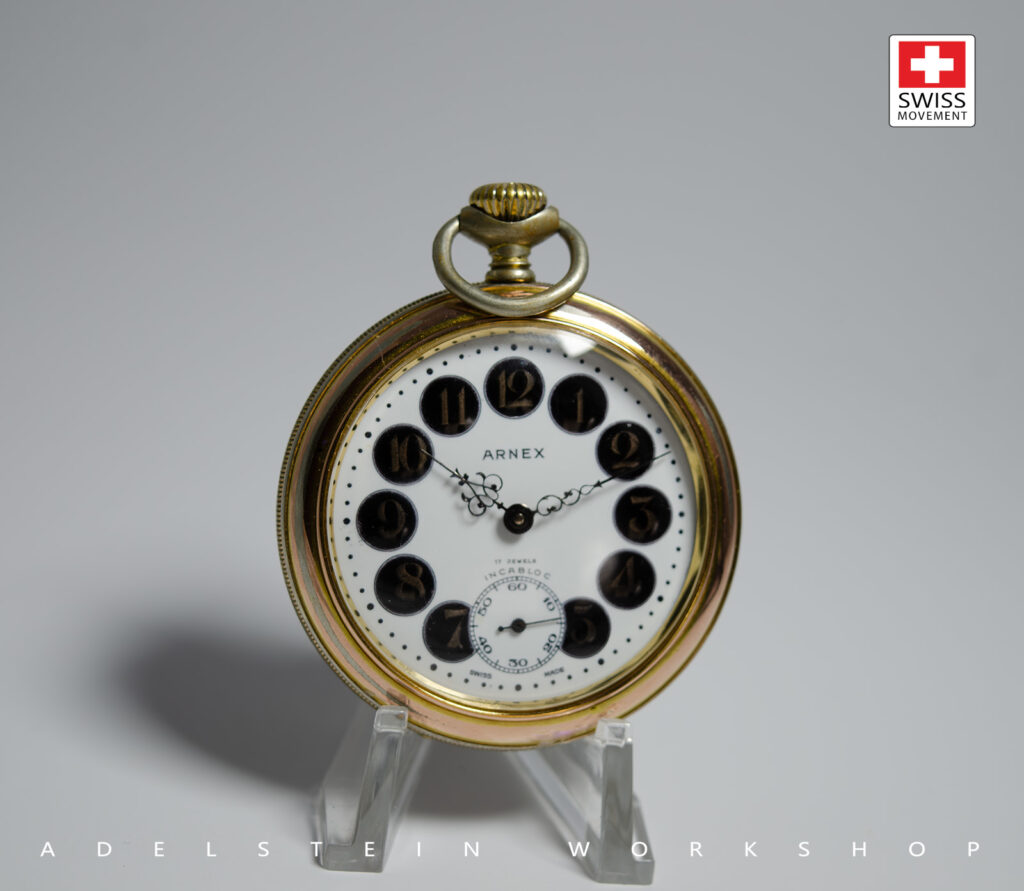
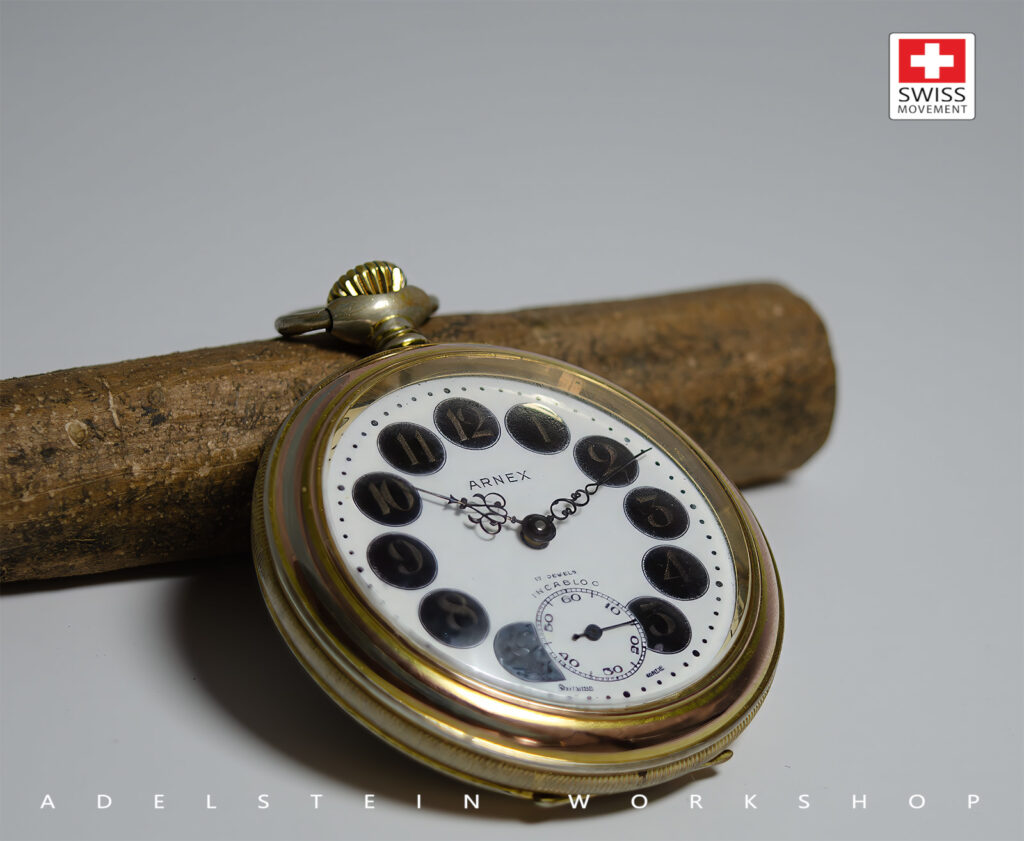
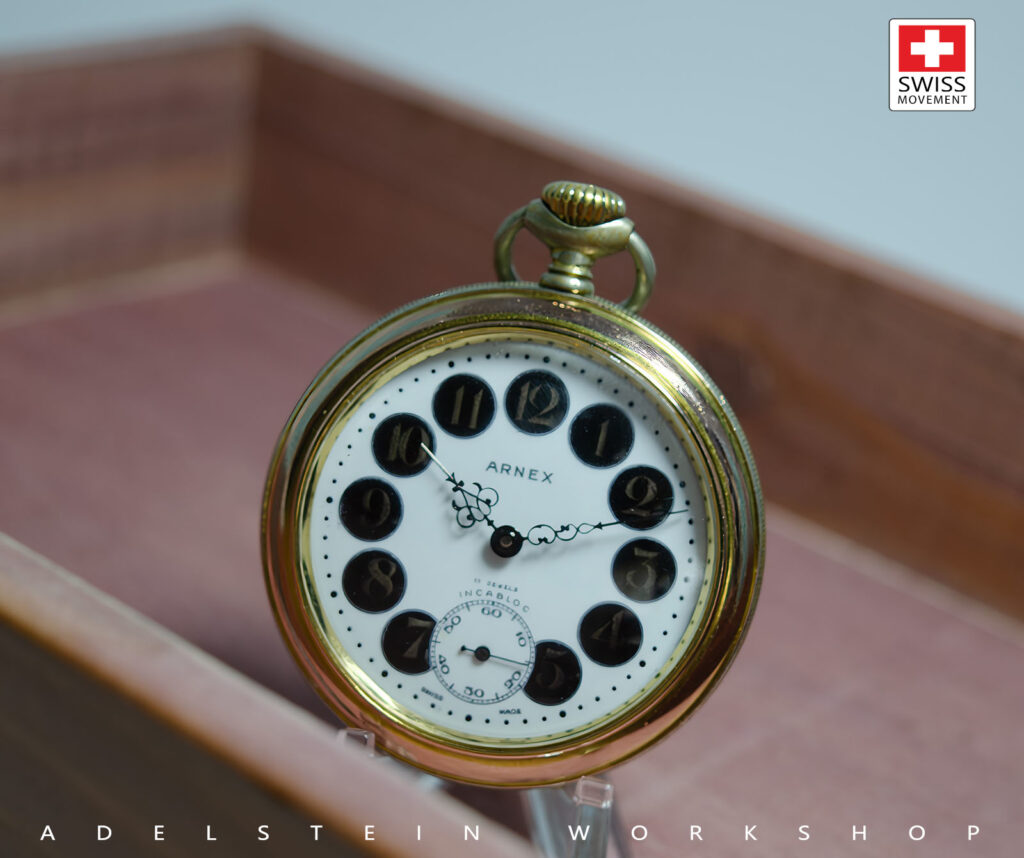
At first glance, this vintage Arnex pocket watch is elegant: a fired porcelain enamel dial with cartouche numerals, a bronze open-face case, and the unmistakable charm of Swiss craftsmanship. But beneath the dial lies something far more intriguing—a Unitas Caliber 431, a rare and historically significant movement that elevates this watch from collectible to conversation piece.
This piece stands apart in a world where Arnex is often associated with mass-market affordability. It’s a mechanical outlier, a survivor from a transitional era in horology, and a testament to the enduring value of thoughtful restoration.
Arnex and the Swiss Export Boom
Founded in 1971 by Arnold Fuchs, Arnex SA was created with a clear mission: to produce affordable Swiss pocket watches for the American market. The company quickly scaled production, offering watches that were stylish, functional, and accessible to nearly every budget.
Arnex watches were often powered by Unitas 6497 movements—reliable, inexpensive, and easy to service. Cases were typically made from base metals, dials from printed metal or acrylic, and crystals from plastic. These watches flooded department stores and gift catalogs throughout the 1970s and early ’80s, making Arnex a household name among casual buyers.
But this watch is different.
Inside the Unitas 431 – Specs and Significance
The Unitas Caliber 431 predates Arnex itself. Produced between the 1940s and 1960s, it was designed as a significant, hand-wound movement for traditional pocket watches. With its 18.5 ligne diameter (~41.7 mm), 17 jewels, and 18,000 bph beat rate, the 431 offered smooth operation and a generous power reserve of ~41 hours.
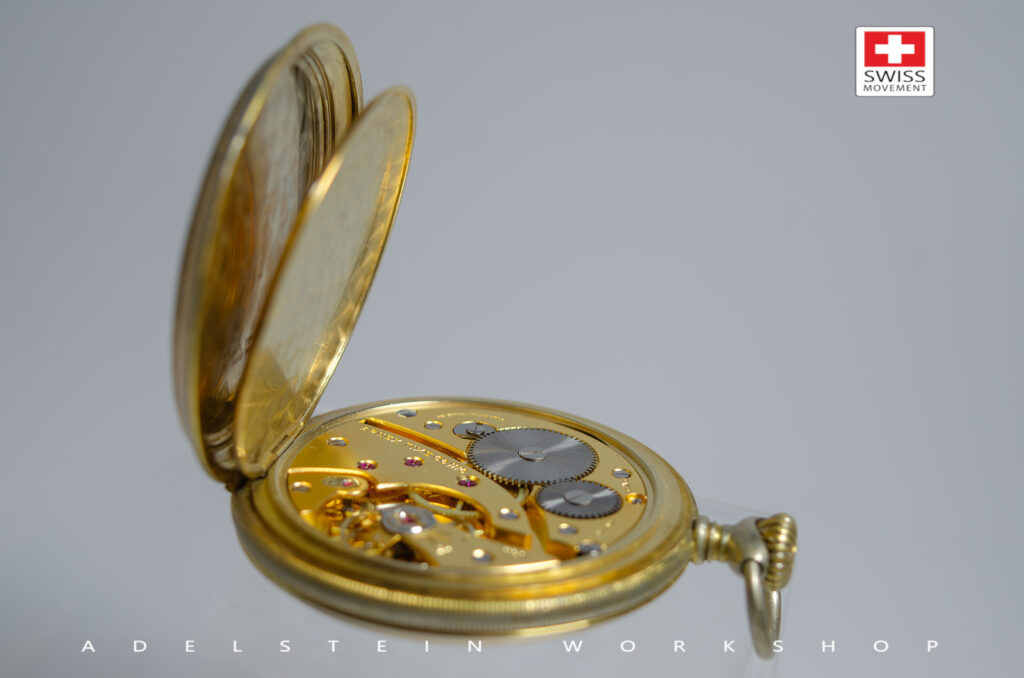
Unlike the later 6497 and 6498, which became ubiquitous in both pocket and wristwatches, the 431 was produced in relatively low volumes. It lacks modern features like hacking seconds or Incabloc shock protection, but its architecture is clean, robust, and highly serviceable.
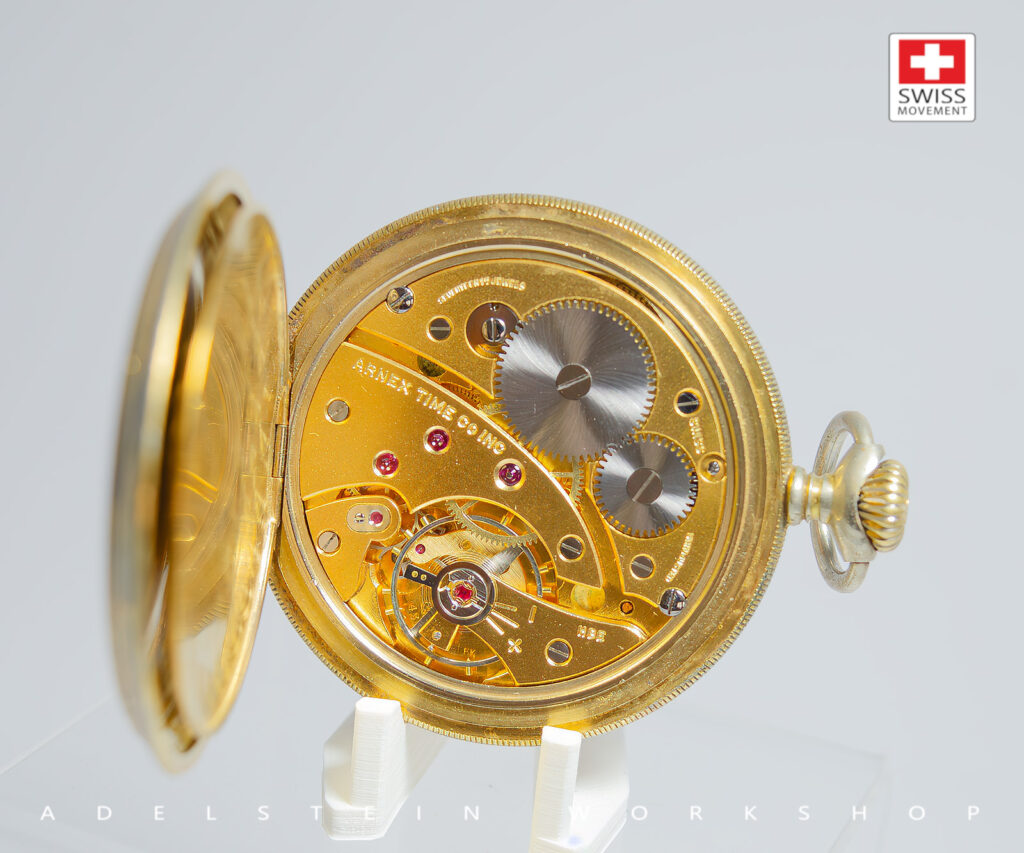
Specs at a glance:
- Movement: Unitas 431 (manual wind)
- Jewels: 17
- Beat Rate: 18,000 bph
- Diameter: 41.7 mm (18.5 lignes)
- Height: 4.7 mm
- Functions: Hours, minutes, small seconds at 6:00
- Stem: 988L
- Country of Manufacture: Switzerland
A Brief Detour—Waltham’s Influence on the Era
To fully appreciate the 431’s place in horological history, we must look briefly at Waltham, the American watchmaking giant that pioneered industrialized timepiece production in the 19th century. By the 1950s, Waltham’s U.S. operations had ceased, and the brand name was licensed to Swiss firms who continued producing watches under the Waltham label.
Some of these “Swiss Walthams” were powered by the Unitas 431, moving a mechanical bridge between American branding and Swiss engineering. While this Arnex isn’t a Waltham, the 431’s presence in both brands underscores its role in a pivotal transitional era.
Why This Arnex Is So Unusual
Arnex typically used the 6497 in its pocket watches—a movement that was cheaper to produce and more widely available. The presence of a Unitas 431 in this watch is highly unusual, suggesting one of two possibilities:
- Early Production: This could be an early Arnex model assembled using surplus Swiss movements before the company standardized on the 6497.
- Special Batch or Private Label: Arnex often produced watches for other brands. This piece may have been part of a limited run or private-label order that called for a higher-grade movement.
Either way, it’s a rare configuration—and one that collectors are unlikely to encounter again.
Restoration Notes – Preserving the Past
When this watch arrived at our workshop, it was a textbook case of hidden potential. The fired porcelain enamel dial had survived beautifully, with its cartouche-style Arabic numerals still crisp and legible. The bronze case showed honest wear but retained its structural integrity.
The movement, however, needed attention. It was carefully disassembled, cleaned, and reassembled using original Swiss components. The balance was regulated, the mainspring lubricated with modern synthetic oils, and the dial and hands were preserved in their original state. No shortcuts. No compromises.
The result? A fully functional, historically significant timepiece that now ticks with the same rhythm it did half a century ago.
Why Collectors Should Pay Attention
This isn’t just a vintage pocket watch—it’s a mechanical artifact. Here’s why it matters:
- Rarity: The 431 is seldom seen in Arnex watches, making this piece a true outlier.
- Historical Value: It represents a transitional moment in Swiss watchmaking, when surplus movements met export-driven design.
- Mechanical Integrity: The 431 is a joy to service and a pleasure to wind—smooth, deliberate, and built to last.
- Aesthetic Appeal: The fired enamel dial and bronze case offer a visual warmth that modern watches can’t replicate.
For collectors, this is a chance to own something that’s both beautiful and historically meaningful.
Ownership & Care
If you’re fortunate enough to own a watch like this, here’s how to keep it ticking:
- Winding: Daily, with gentle pressure—stop when resistance increases
- Storage: Keep away from magnets and moisture; store dial-up in a soft pouch
- Servicing: Every 3–5 years by a qualified watchmaker familiar with vintage calibers
- Display: Consider a glass dome or stand to showcase the dial and movement
This isn’t just a watch—it’s a legacy.
Final Thoughts – Time, Preserved
In an era of disposable tech and digital distractions, this Arnex pocket watch offers something rare: tangible timekeeping with a soul. It’s not just about nostalgia—it’s about honoring the ingenuity, precision, and artistry that defined a generation of watchmakers.
At Watchmasters, we don’t just sell watches—we preserve legacies. And this Unitas 431-powered Arnex is one worth remembering.
For a deeper look at Arnex’s origins, see our research article on the Claude Wollman myth.
Now available from US Watch Masters:
This remanufactured Arnex 431 pocket watch is being offered exclusively to collectors via eBay.
View the listing on eBay →