At US Watch Masters, we believe that the greatest timepieces emerge when uncompromising function creates unexpected beauty. No watch exemplifies this principle better than the German Beobachtungsuhr (B-Uhr) of World War II—a military instrument so perfectly designed for its purpose that it became one of horology’s most enduring icons.
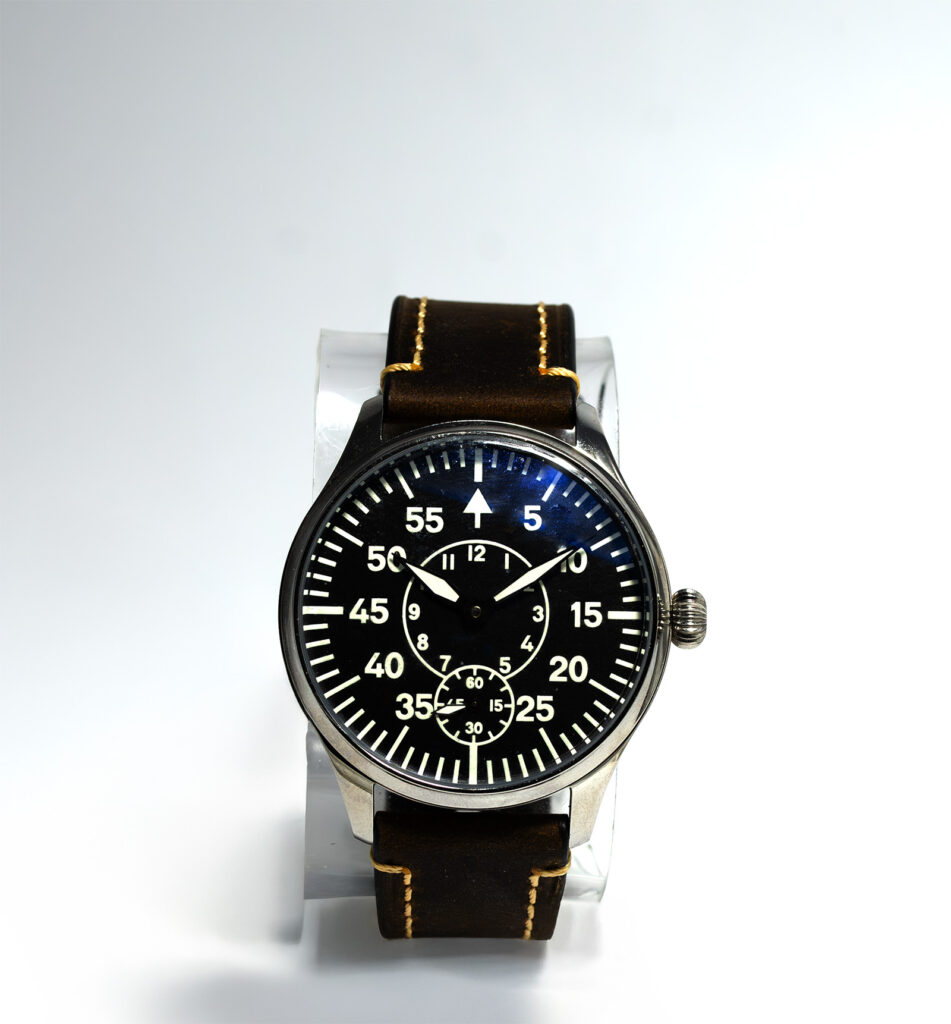
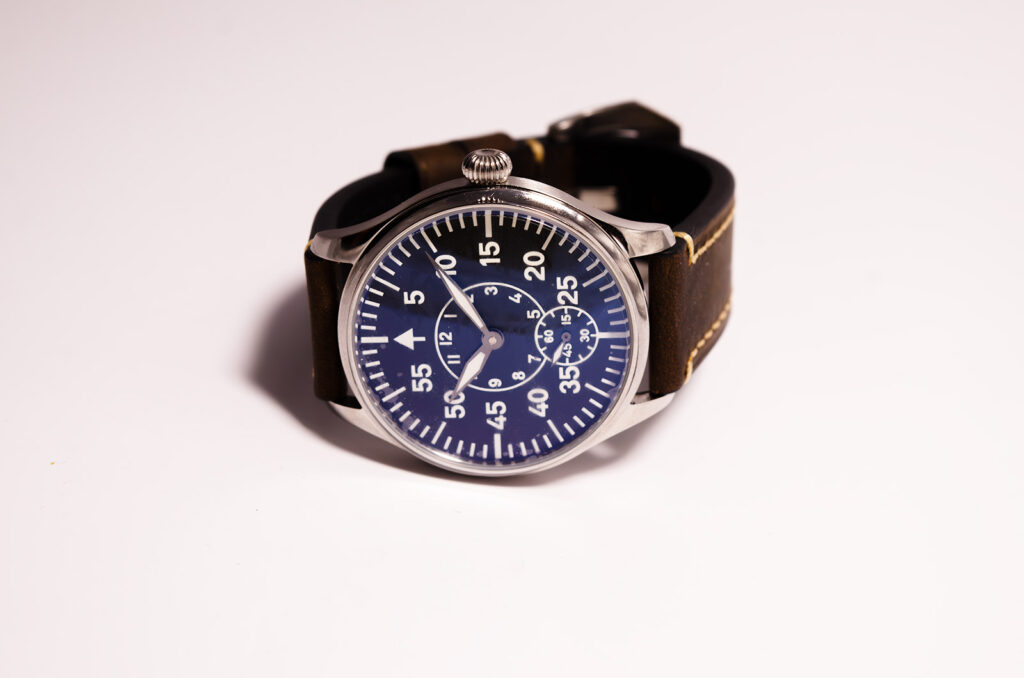
This clean reference image showcases the practical beauty of the B-Uhr—a timepiece engineered for legibility, worn in flight, remembered in history.
Historical Foundation: When Lives Depended on Precision
The German Luftwaffe’s long-range bombing campaigns of the late 1930s created an unprecedented demand for navigational precision. Before GPS and advanced radio beacons, bomber navigators relied on celestial navigation and dead reckoning across hundreds of miles of hostile territory. A single timing error could mean the difference between hitting a strategic target and missing it entirely—or worse, never finding home.
The Reichsluftfahrtministerium (RLM) responded with specifications that were so exact that they left no room for stylistic interpretation. Five manufacturers—A. Lange & Söhne, Laco, Stowa, Wempe, and IWC produced identical instruments governed by pure function:
The 55mm case wasn’t oversized for fashion—it housed large, pocket watch-derived movements necessary for chronometer accuracy while remaining legible in a vibrating cockpit.
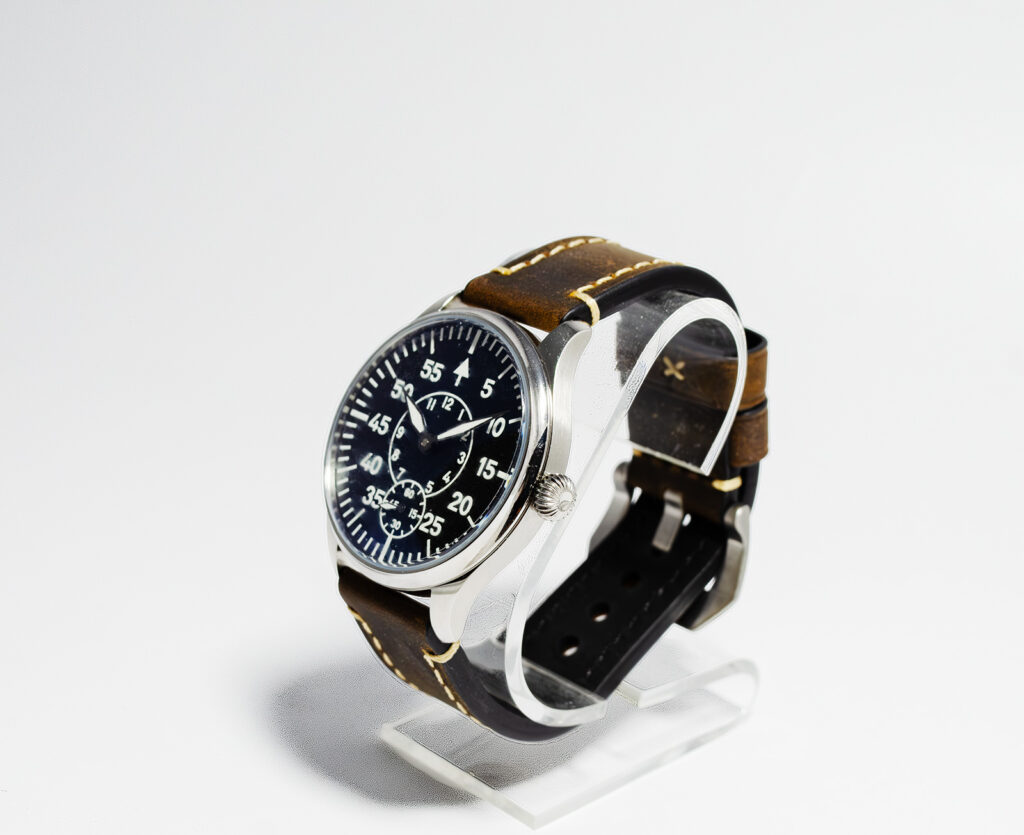
The massive “onion” crown enabled operation by aviators wearing thick, insulated gloves.
The stark black dial with luminous markers provided maximum contrast in the dim light of a bomber’s navigation station.
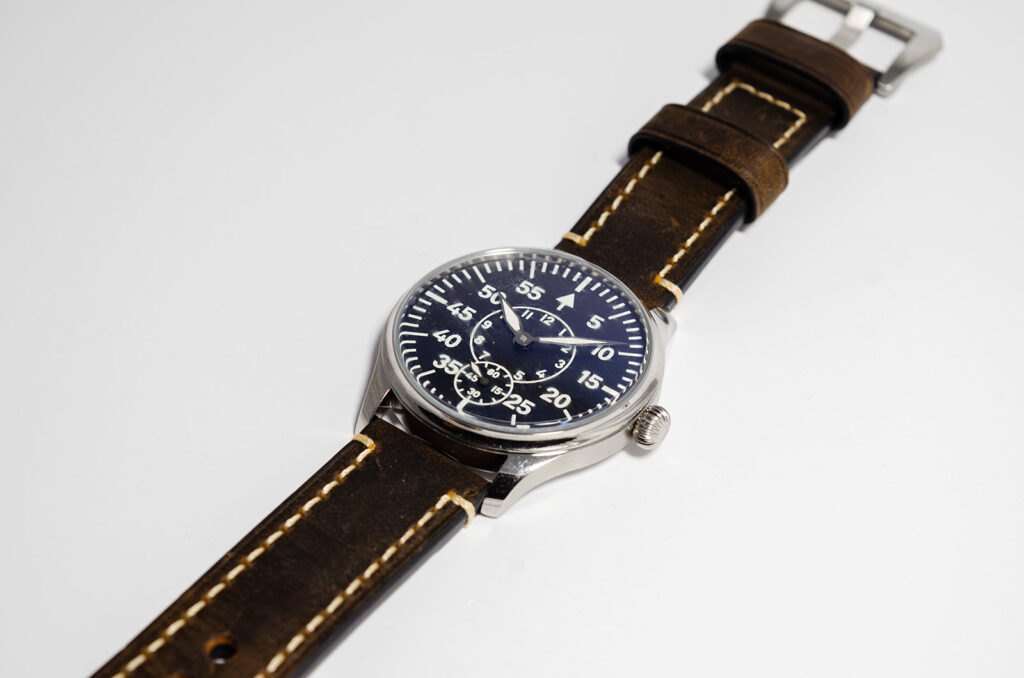
The face of this B-Uhr tells a story of wartime utility and enduring horological design. Discover the function-first layout that defined an era.
The hacking seconds mechanism allowed precise synchronization across entire squadrons, which was critical for coordinated tactical operations.
Our Modern Interpretation: Honoring the Legacy
Drawing from this profound heritage, Adelstein Workshop has created a contemporary Flieger that honors the originals’ historical integrity while offering the reliability and finish of modern craftsmanship.
The Heart: Authentic Swiss Unitas 6498
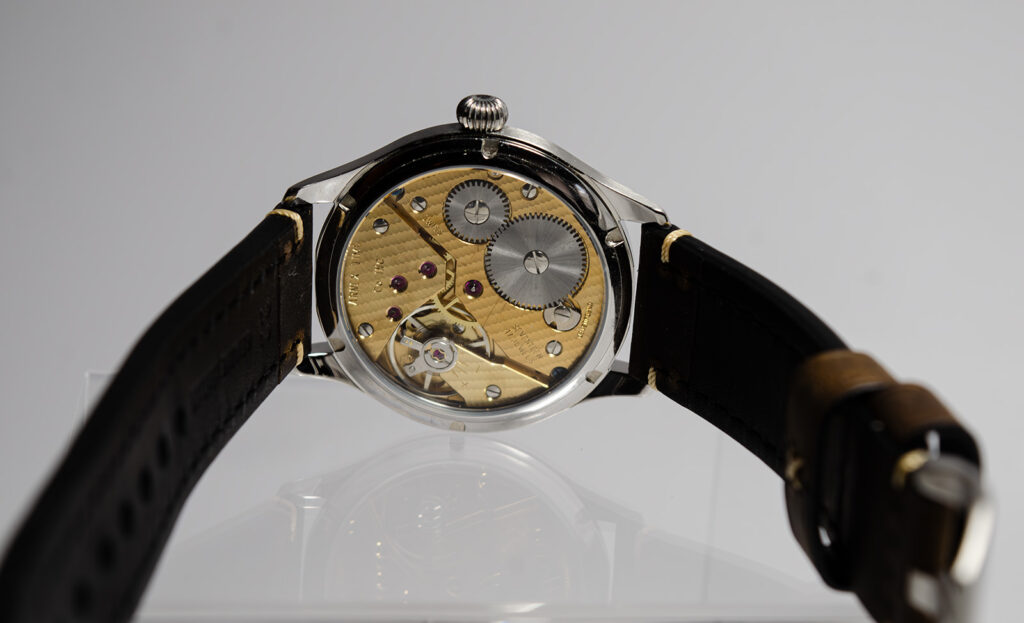
At the core of our Flieger beats an authentic vintage Swiss Unitas 6498—not a modern reproduction, but a genuine movement with direct lineage to the robust calibers that powered the original B-Uhren. These movements, initially designed for pocket watches in the 1950s, represent the same engineering philosophy that made the wartime instruments reliable.
Our restoration process is what sets us apart from the competition:
Each movement is meticulously selected from rarely-used vintage pocket watches
Complete disassembly and ultrasonic cleaning remove decades of accumulated oils and debris
All degraded components are replaced with period-appropriate parts
Modern lubricants provide longevity while maintaining authentic operation
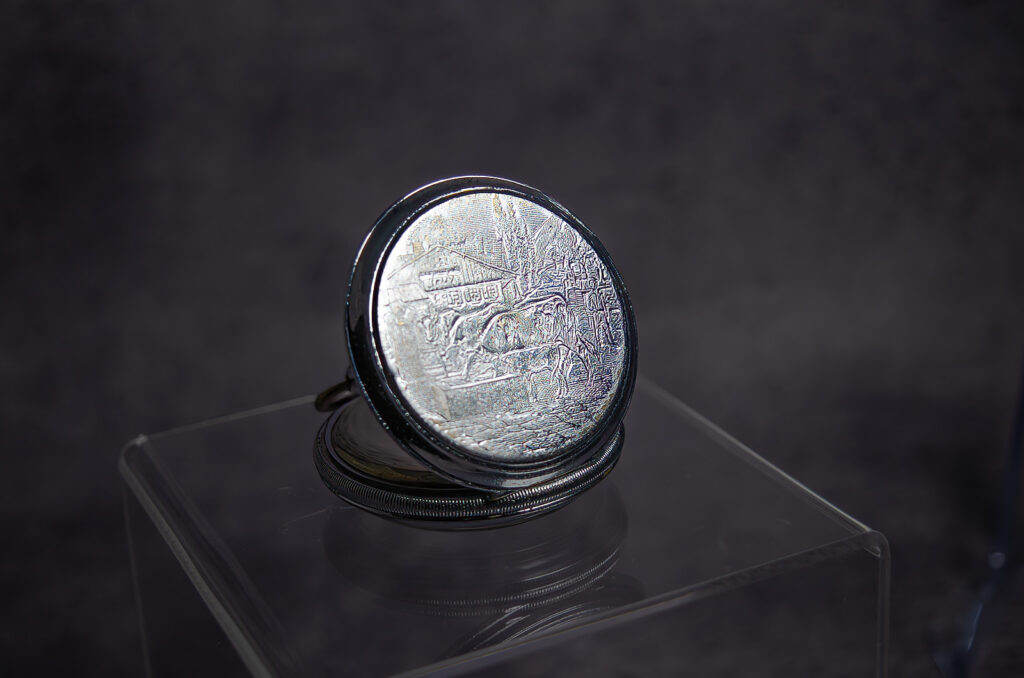
“The Beobachtungsuhr’s caseback reveals serial markings unique to this model.”
The Build: Contemporary Excellence
While honoring historical specifications, our new build incorporates the finest modern materials and finishing techniques:
Precision-machined stainless steel case with period-correct proportions
Museum-quality dial reproduction featuring proper typography and layout
Swiss-made luminous materials for superior longevity and safety
Handcrafted leather strap with contrasting stitching that echoes military issue
Presentation case worthy of this exceptional timepiece
The US Watch Masters Difference
Why our Flieger stands apart in today’s market:
This on-wrist photograph captures the timeless design of the B-Uhr—practical in war, iconic in peace. A symbol of aviation history reborn.
Authentic vintage movement restoration – While others use modern movements or basic vintage pieces, we source exceptional examples and restore them to master standards
Historical accuracy – Our research ensures every detail reflects the original RLM specifications
Master craftsmanship – Every component meets the standards expected from the original manufacturers
One-year warranty – We stand behind our work with comprehensive coverage
Provenance documentation – Each watch includes detailed information about its movement’s history and restoration
A Living Piece of History
The post-war period saw the B-Uhr transform from military instrument to horological icon. Divorced from its martial context, its design was reappraised through the lens of pure aesthetics. The very features born of necessity—stark legibility, unadorned functionality, robust construction—were recognized as virtues of timeless design.
Our Flieger continues this evolution. It’s not merely a reproduction, but a living interpretation that honors the past while serving the present. Whether worn by aviation enthusiasts, watch collectors, or those who appreciate authentic design, it connects the wearer to a tradition where form follows function to perfection.
This reference-style photo displays the full face of a WWII-era B-Uhr with signature subdial layout, offering an archival look at mission-first design.
Available exclusively through our US Watch Masters brand, each Adelstein Workshop Flieger represents the convergence of historical significance, master restoration, and contemporary excellence. For the discerning collector who values heritage and craftsmanship, this is more than a timepiece—it bridges horological eras.
[Contact us to reserve your piece of aviation history]
You can also purchase this item directly from our eBay store.
A Case Study in the Hidden Complexities of Vintage Timepiece Preservation
How Ted Sees a Ticking Watch
When Ted Tongson first encounters a vintage Swiss watch that “runs,” he doesn’t smile—he squints. What most collectors interpret as a promising tick, Ted hears as a warning. He doesn’t wind it further, doesn’t test its timekeeping. He sets it down like a forensic examiner and says quietly, “It’s moving—but we don’t know what it’s doing to itself.”
For Ted, function is not the priority, but evidence is. Every watch that crosses his bench at US Watch Masters begins with silence: the case unopened, the movement untouched. He listens first, not to the reassuring tick that seduces buyers, but to the subtle irregularities that reveal internal distress. He examines its amplitude with practiced eyes. He checks the crown’s tension, feeling for the telltale resistance that speaks of crystallized lubricants within.
Only then does he open it—not to admire the ticking, but to interrogate the surfaces that make it tick. Are the oils crystallized into amber-colored resin? Are there microscopic abrasion tracks scoring the jewel bearings? Has the mainspring torqued beyond its safe operational arc, stressed by decades of compromised lubrication? These questions matter infinitely more than whether the hands complete their circuit around the dial.
To Ted, motion without maintenance is a mask—an elaborate deception that conceals mechanical destruction in progress. The watch may tick today, but each oscillation on degraded lubricants removes microscopic particles of hardened steel from pivot points, each gear rotation grinds away teeth designed to last centuries, and each mainspring cycle stresses components already weakened by decades of chemical assault.
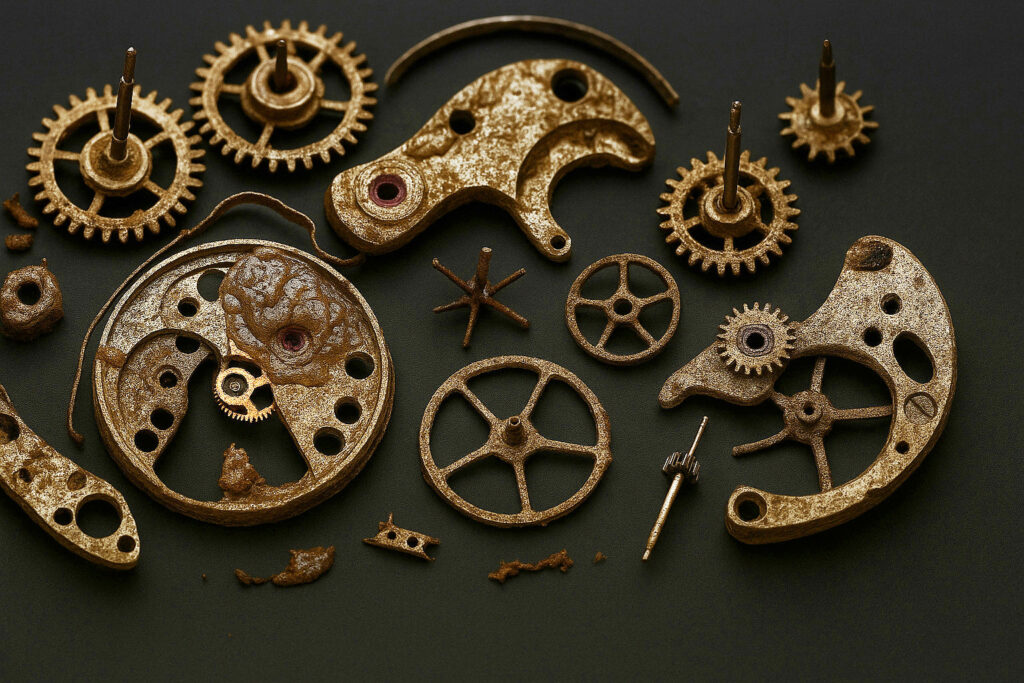
The restoration begins when the watch is fully disassembled, cleaned, and examined part by part under magnification—not with hope but with proof. Not with assumptions about function but with evidence of what that function costs the mechanism beneath.
This methodical skepticism puts Ted at odds with a vintage watch market that celebrates what he sees as dangerous: the seductive promise of the “running” watch.
The Dangerous Allure of the “Running” Watch
Hundreds of vintage pocket watches appear on auction sites on any given day with the same seductive promise: “Runs and keeps time.” The photographs show hands sweeping around pristine dials, second hands marking a steady rhythm, and sellers confidently declaring functionality. To the uninitiated collector, these timepieces represent ready-to-wear pieces of horological history at attractive prices.
They represent something else entirely: mechanical time bombs.
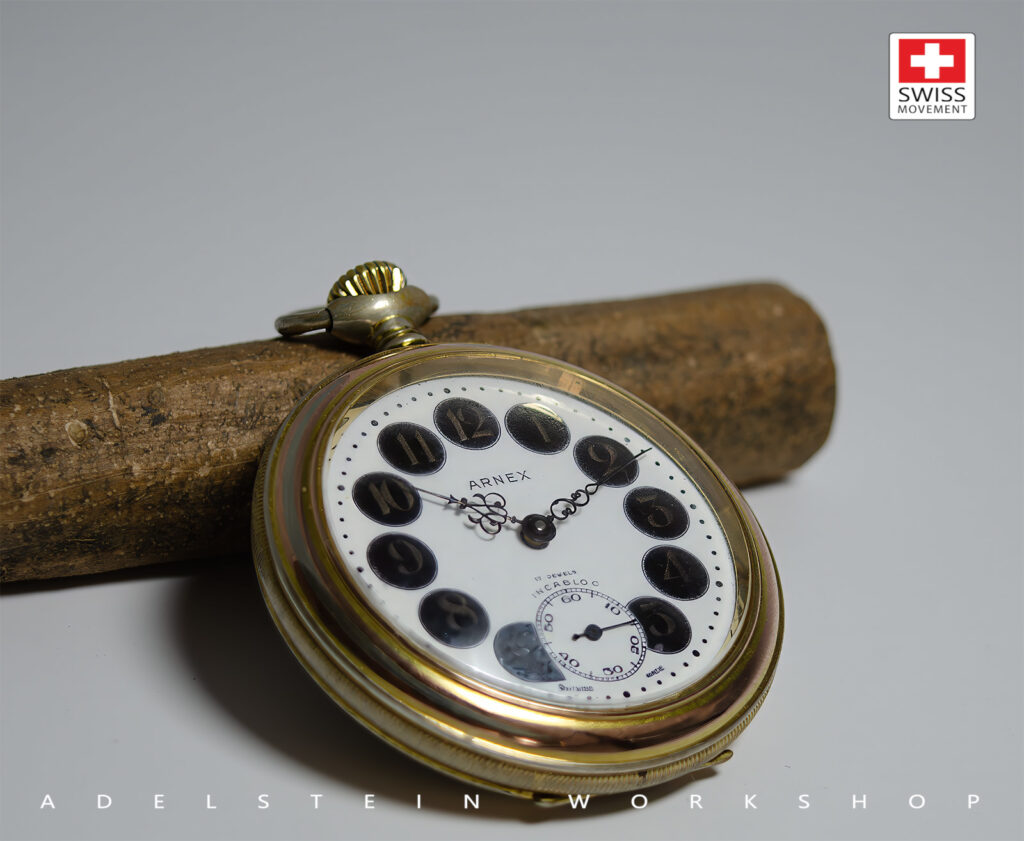
Consider this 1950s Arnex 14k gold pocket watch, currently listed as “running and keeping time.” The seller’s description emphasizes its operational status, clean appearance, and reasonable asking price. For most buyers, this represents exactly what they’re seeking: a functional vintage timepiece that doesn’t require immediate investment in restoration.
This watch—and thousands like it—embodies one of the most persistent and costly misconceptions in vintage horology: that movement equals proper function.
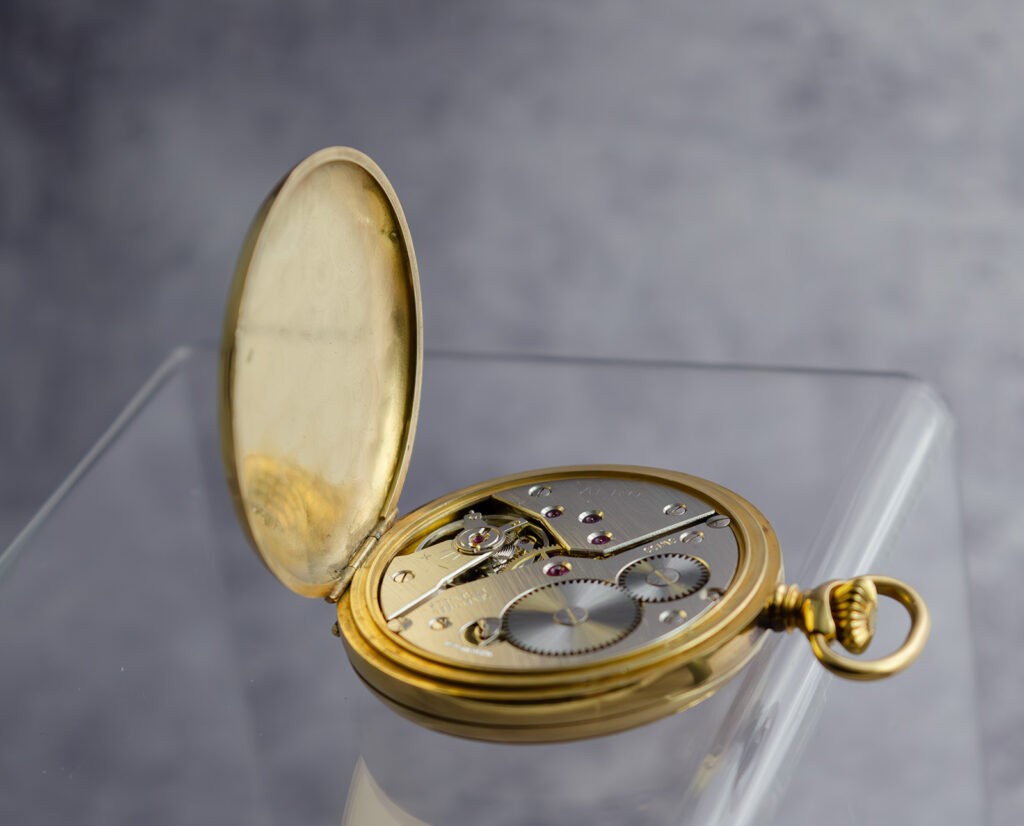
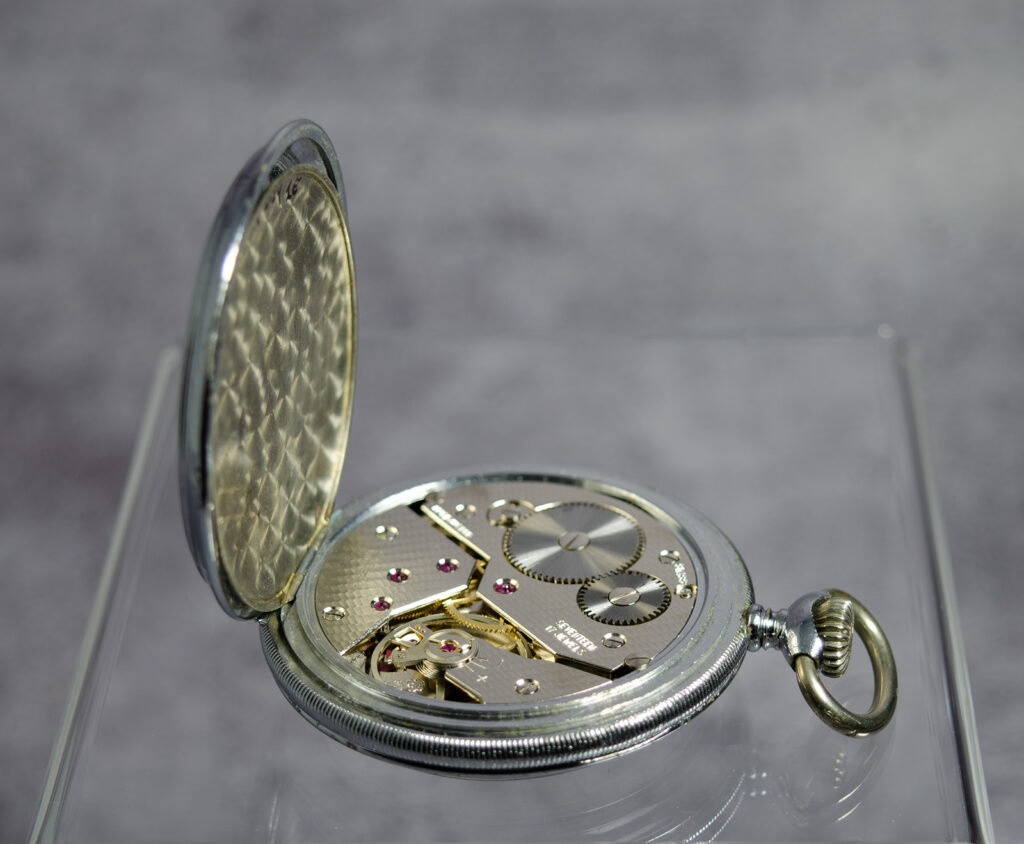
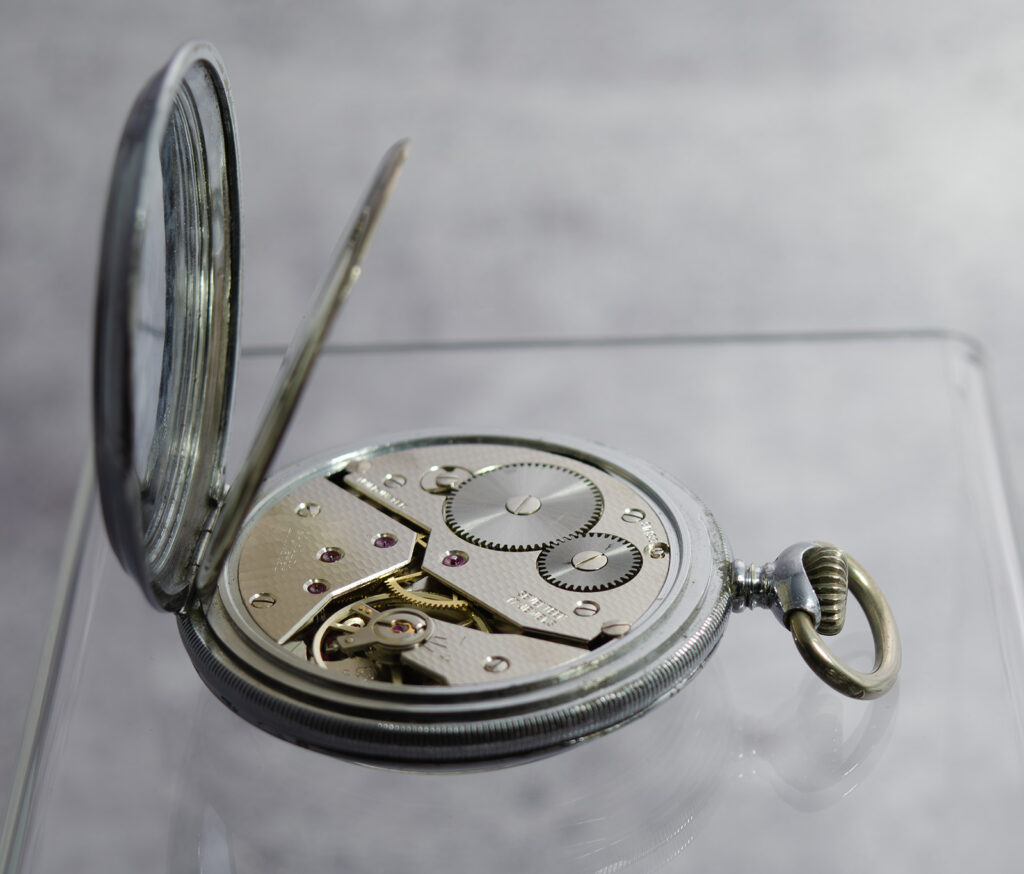
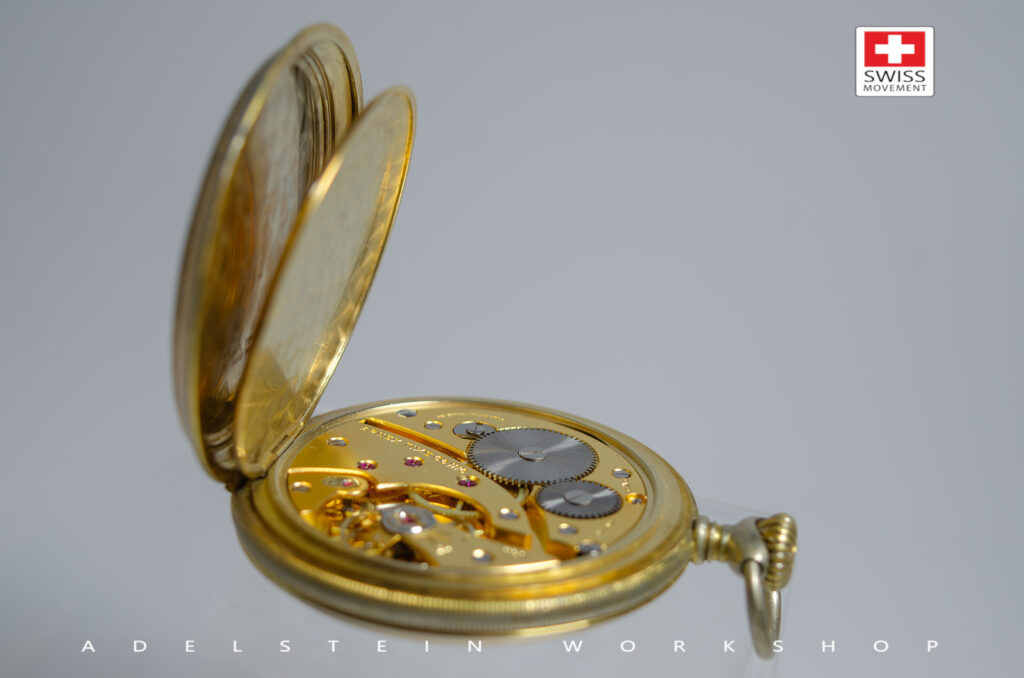
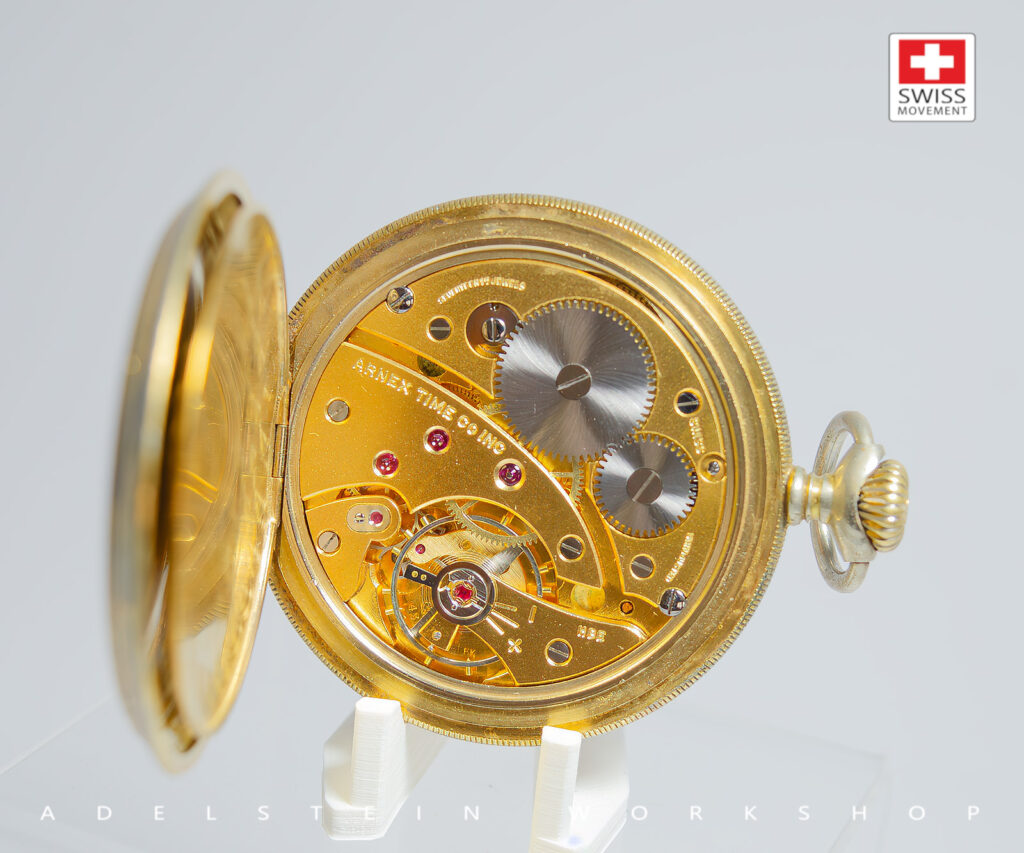
Inside the Arnex: The original Unitas 6498 movement prior to restoration—solid, intact, and poised for revival.
The Tribology of Self-Destruction
Inside that “running” Arnex, a complex drama of mechanical degradation unfolds with every tick. The movement, likely unserviced for decades, operates on lubricants that have long since transformed from protective barriers into abrasive compounds. What watchmakers call “unctuous lubrication”—the specialized molecular bonding that allows lubricants to function under the high-pressure, low-speed conditions within a watch movement—has failed.
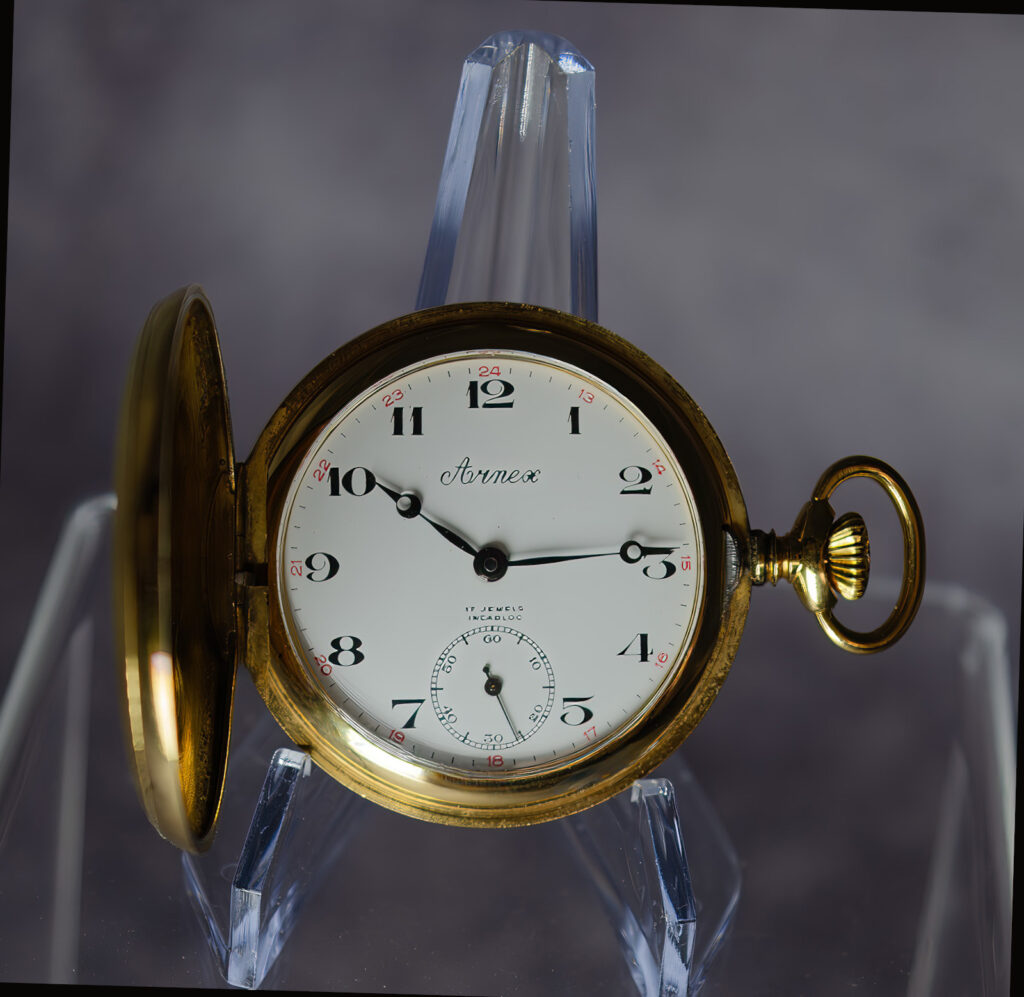
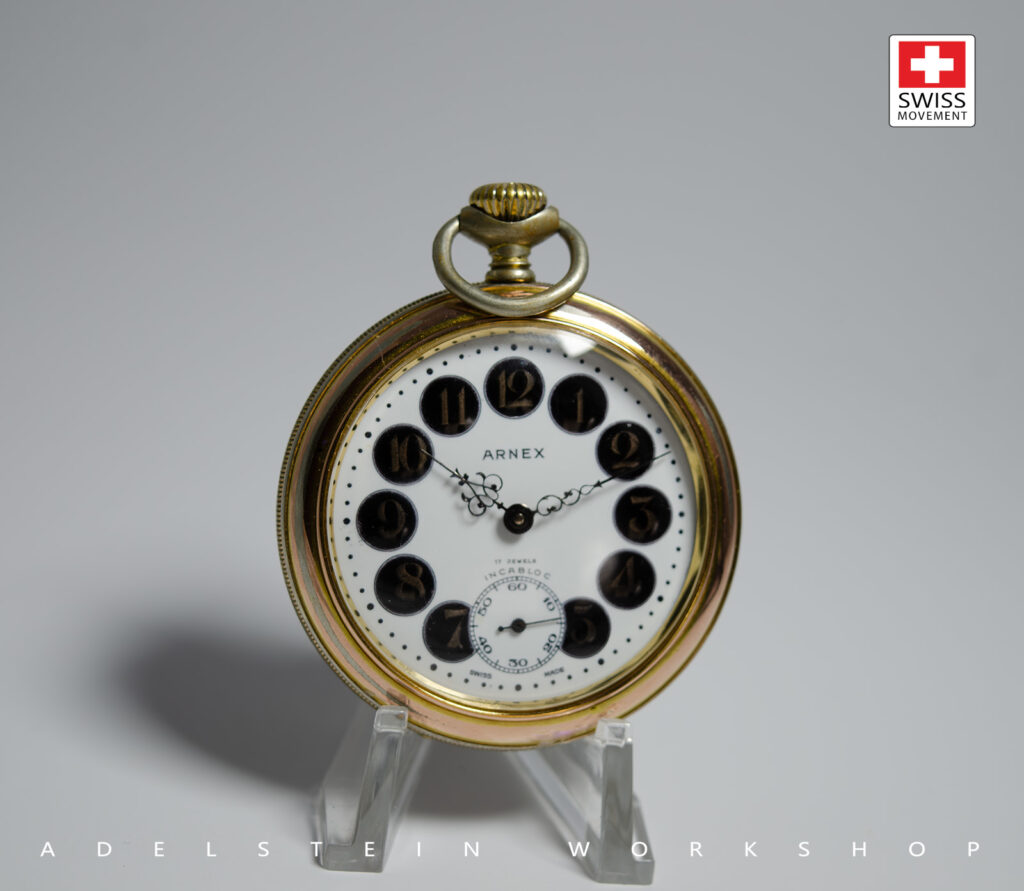
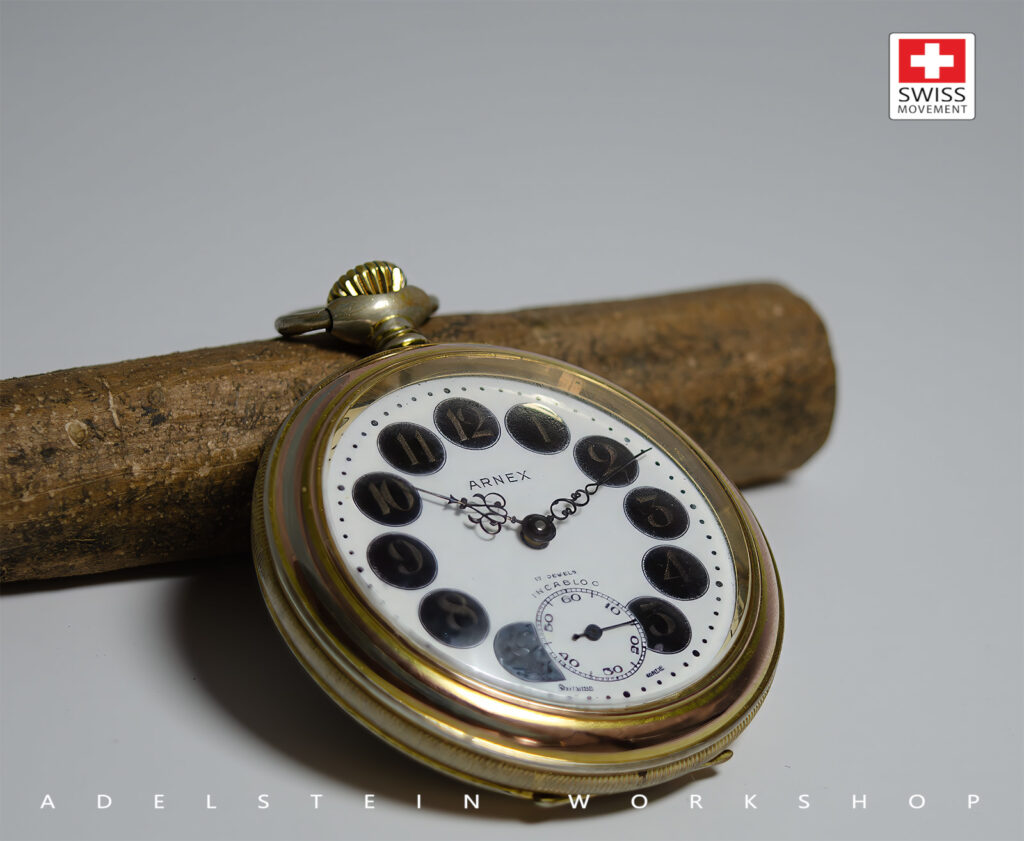
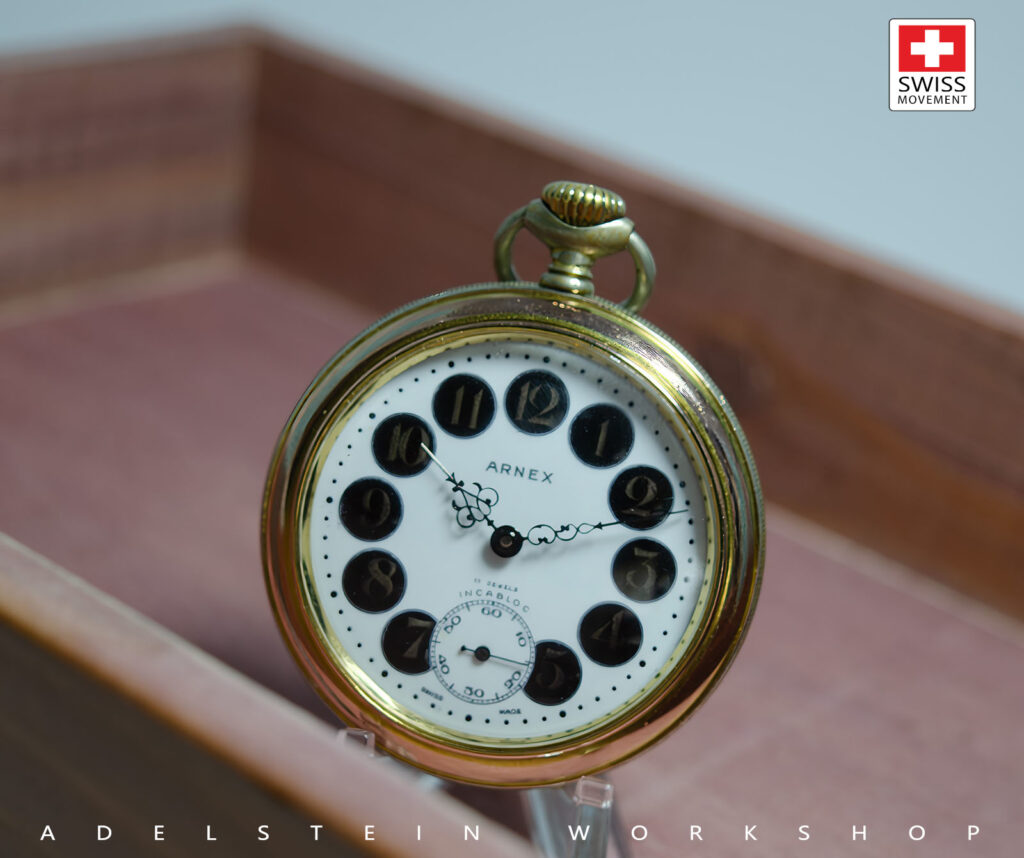
The deceptively clean dial of a vintage Swiss watch—mechanically untouched but not yet safe for service.
Modern synthetic lubricants like Moebius 9010 are designed to maintain their protective properties for 5-8 years under optimal conditions. Beyond that timeframe, oxidation and molecular breakdown create lubricants that accelerate rather than prevent wear. The irony is devastating: the oils meant to preserve the movement become agents of destruction.
When aged lubricants thicken into glue-like substances, they create what tribologists recognize as catastrophic lubrication failure. Pivot points designed to operate with coefficients of friction measured in thousandths suddenly experience metal-on-metal contact. Jewel bearings, those synthetic corundum marvels engineered for frictionless rotation, become repositories for crystallized oils that function like grinding compound.
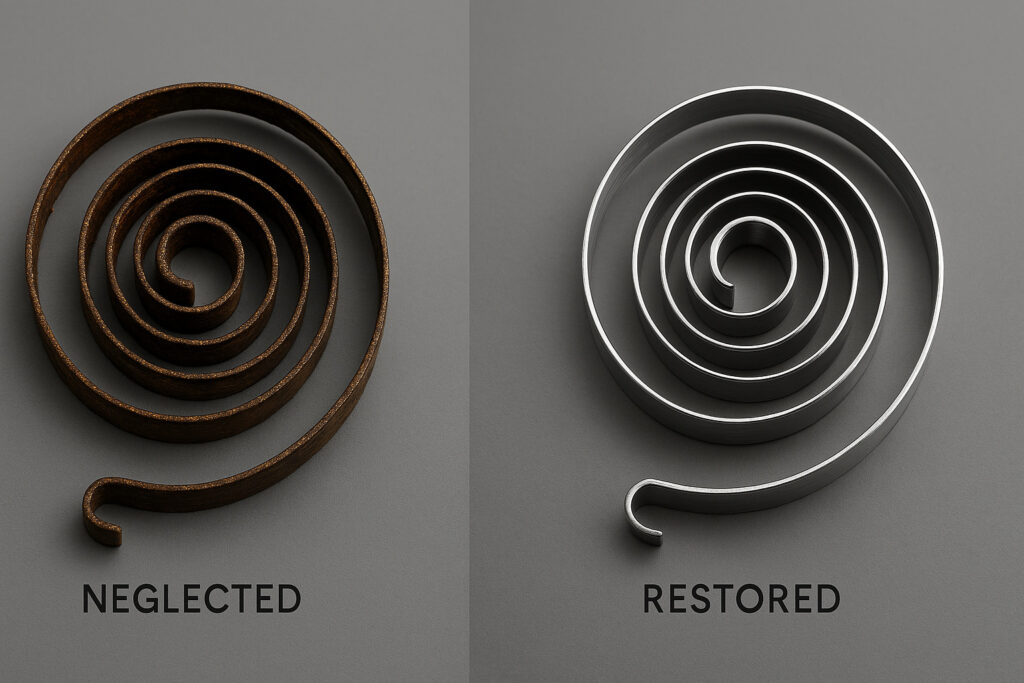
The Arnex continues to tick because mechanical watches are remarkably resilient. The basic physics of escapement and balance wheel can function even under severely compromised conditions. But each oscillation now removes microscopic particles of hardened steel from pivot points, each gear rotation grinds away teeth, and each mainspring rotation stresses components already weakened by decades of chemical assault.
The Economics of Deferred Maintenance
The vintage watch market’s pricing structure actively encourages this mechanical destruction. “Running” watches command premiums that can exceed restoration costs, creating perverse incentives where immediate functionality is rewarded over long-term preservation. The Arnex’s current asking price reflects this market distortion—buyers pay extra for the privilege of owning a timepiece that’s actively destroying itself.
Recent market analysis shows vintage watches from the 1950s-1960s appreciating steadily, having already absorbed their depreciation curves. Unlike modern timepieces that typically lose value for 10-20 years, vintage pieces like the Arnex represent “clear winners in terms of investment and sustainability.” However, this appreciation potential evaporates rapidly when compromised movements require extensive reconstruction rather than preventive maintenance.
Professional restoration, while requiring upfront investment typically ranging from $400-800 for a complete service, represents superior economic logic when amortized over a timepiece’s extended functional life. The alternative—continued operation on failed lubricants—virtually guarantees eventual repairs costing significantly more than preventive restoration, often involving component replacement that could have been avoided entirely.
The Restoration Imperative: Science Over Sentiment
Proper restoration transcends the simple cleaning and oiling of most commercial watch repairs. It requires complete disassembly, multi-stage cleaning using specialized horological degreasers, ultrasonic treatment, and component-by-component examination under magnification. Each piece must be evaluated for wear patterns that indicate the progression of tribological failure.
The lubrication process alone involves multiple specialized oils applied in precisely measured quantities. Light oils like Moebius 9010 serve high-speed, low-pressure contact points in the gear train. Heavy oils and greases like Moebius HP 1300 handle higher-pressure applications in barrel arbors and wheel shoulders. Specialized treatments like Fixodrop 8941 prevent oil migration, ensuring lubricants remain precisely where needed for optimal function.
This systematic approach differs fundamentally from the surface interventions that allow watches to “run.” Professional restoration addresses the root causes of mechanical degradation rather than merely managing its symptoms. The result is not just renewed function but extended operational life measured in decades rather than months.
The Authentication of Expertise
Perhaps the most telling indicator of restoration quality lies in the warranty offered by the service provider. The vintage watch market typically operates without guarantees—sellers acknowledge implicitly that their “running” timepieces carry uncertain futures. When restoration workshops offer multi-year warranties on their work, they make contractual commitments possible only through confidence in their technical competence and procedural thoroughness.
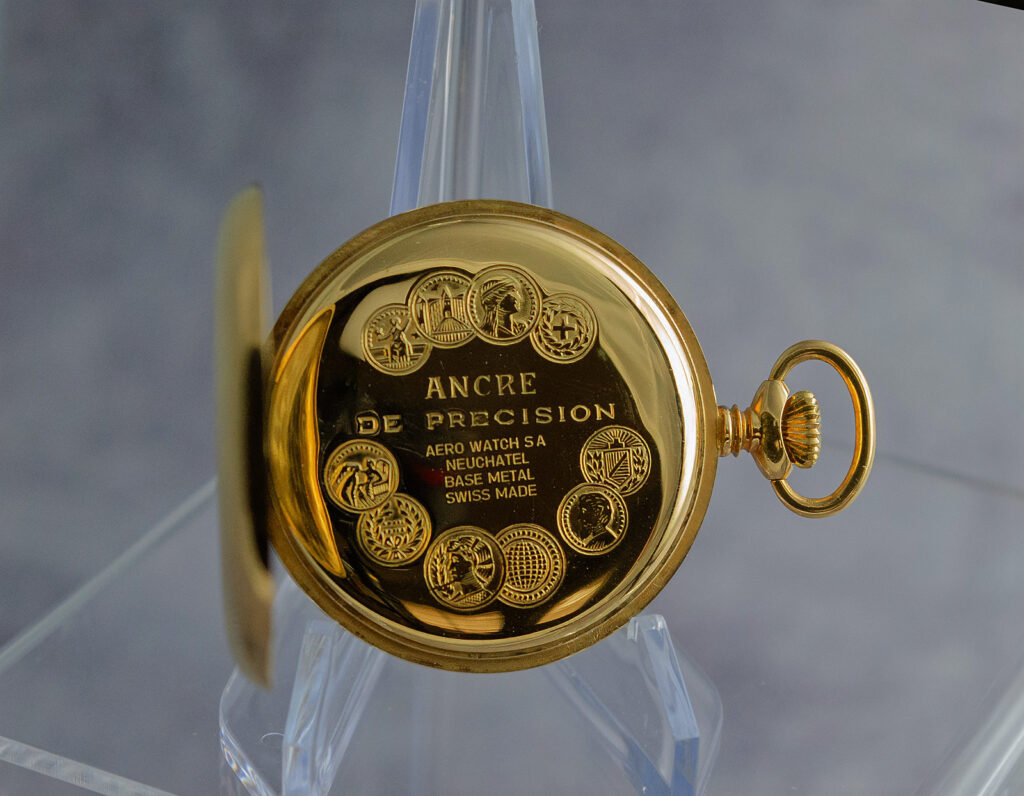
Ancre de précision’—the engraved promise of Swiss horology.
At US Watch Masters, every restored timepiece carries a two-year parts and labor warranty that most vintage sellers wouldn’t dare offer. This guarantee reflects more than marketing confidence; it represents the mathematical probability that properly executed restoration will provide reliable service. When lubricants are correctly specified and applied, when component tolerances are verified and documented, and when reassembly follows original manufacturing protocols, the restored movement’s behavior becomes predictable within known parameters.
This predictability extends beyond mere function to precision timekeeping. Properly restored movements undergo regulation involving beat error measurement, amplitude adjustment, and multi-position testing. The goal is not simply motion but accuracy within chronometer specifications—performance that often exceeds the watch’s original factory standards due to advances in lubricant technology and adjustment techniques.
The Cultural Dimension: Preserving Mechanical Memory
The choice between purchasing a “running” watch and commissioning proper restoration carries implications beyond individual ownership. Each mechanical timepiece represents what horologists call “mechanical memory”—the accumulated knowledge, techniques, and cultural values embedded in its construction. When these timepieces operate on compromised lubrication, they degrade mechanically and culturally.
Traditional restoration serves as cultural preservation, maintaining physical artifacts and the knowledge systems required to understand and service them. Master restorers function as custodians of techniques that span centuries, preserving skills that risk disappearing as digital timekeeping dominates contemporary horology. This cultural dimension transforms restoration from mere repair into heritage preservation.
Manufacturers like Vacheron Constantin explicitly acknowledge this responsibility, committing to “perpetuate the beat of a movement sometimes centuries old” through restoration programs that utilize traditional tools alongside modern techniques. This continuity ensures that the artistry and precision of historical watchmaking endure, transmitted through generations of craftsmen who understand that preservation requires more than sentiment—it demands technical mastery.
The Sustainable Alternative
The vintage watch market’s emphasis on immediate functionality reflects broader cultural patterns prioritizing convenience over longevity. The “running” watch represents the horological equivalent of planned obsolescence—acceptable short-term performance that virtually guarantees eventual failure. This approach contradicts the fundamental design philosophy of mechanical timepieces engineered for indefinite operation through periodic maintenance.
Proper restoration aligns with the original design intent while supporting sustainable consumption patterns. Unlike mass-produced consumer electronics designed for replacement cycles, mechanical watches can theoretically operate indefinitely when properly maintained. This longevity makes restoration an act of sustainable consumption that contradicts disposable culture while supporting traditional craftsmanship.
The environmental implications extend beyond individual timepieces to the preservation of manufacturing knowledge. Traditional watchmaking techniques, developed over centuries of refinement, represent irreplaceable cultural resources. When vintage timepieces receive proper restoration, they support the economic viability of master craftsmen whose skills might otherwise disappear.
Case Study: The Arnex Transformation
Returning to our example, Arnex pocket watch, professional restoration would begin with complete documentation of its current condition, including photographic records and measurement data. Disassembly would reveal the extent of lubricant degradation, component wear, and information guiding restoration strategy and component replacement decisions.
The movement would undergo multi-stage cleaning using specialized degreasers and ultrasonic equipment, removing decades of contaminated oils and accumulated debris. Each component would receive individual examination under magnification, with wear patterns documented and compared against acceptable tolerances. Worn components would be replaced with period-appropriate parts or carefully manufactured reproductions.
Reassembly would follow original factory specifications, with fresh lubricants applied according to contemporary best practices. The completed movement would undergo extended testing under various positions and conditions, verifying accuracy and reliability. The final result would be a timepiece that functions and performs to original specifications while carrying warranty protection unavailable in the vintage market.
The transformation extends beyond mechanical performance to long-term value preservation. A restored Arnex with documented service history and original components maintains appreciation potential that compromised movements cannot match. The restoration investment becomes part of the timepiece’s provenance, evidence of proper stewardship that enhances rather than diminishes collectibility.
The Choice: Motion or Mastery
The vintage watch market offers collectors a fundamental choice between immediate gratification and lasting value. “Running” watches provide instant satisfaction at the cost of mechanical integrity and long-term appreciation. Professional restoration requires patience and investment but delivers authentic function, warranty protection, and heritage preservation.
This choice reflects broader questions about our relationship with craftsmanship and cultural preservation. Do we value the appearance of function over its reality? Are we willing to support the traditional skills that make mechanical timekeeping possible? Will we accept responsibility for preserving artifacts that embody centuries of human ingenuity?
The answers manifest in our decisions about individual timepieces. When we choose restoration over convenience, we support mechanical preservation and cultural continuity. When we demand warranties and documentation, we encourage professional standards that benefit the collecting community. When prioritizing long-term value over short-term savings, we make economic decisions that align with sustainable consumption principles.
Conclusion: The True Measure of Time
A watch that ticks may seem to function, but function requires more than motion. It demands precision, reliability, and confidence from proper maintenance. The difference between a “running” watch and a restored timepiece is between survival, flourishing, mechanical existence, and horological excellence.
The vintage market will continue to offer seductive “running” watches at appealing prices. Collectors who understand the hidden costs of deferred maintenance will recognize these offerings for what they truly represent: mechanical time bombs disguised as bargains. Those who value authentic function over its appearance will choose the more difficult but ultimately more rewarding path of professional restoration.
In an age of disposable technology and planned obsolescence, the mechanical watch is a testament to different values: repairability, longevity, and respect for traditional craftsmanship. The choice to restore rather than merely purchase reflects a commitment to these endangered principles and an investment in their continuation.
The watch on your wrist may tick today, but will it tell time tomorrow? The answer depends not on hope but on the hands that service it—and the standards you demand from those who claim the title of master.
Master Watchmaker | Trusted by Collectors Nationwide | Where Time Finds Its Voice Again
Some timepieces transcend mere function—they embody legacy, whisper stories, and deserve resurrection in their purest form. At Adelstein Workshop, we partner exclusively with master watchmaker Ted Tongson, whose unwavering dedication to mechanical excellence has earned him reverence among discerning collectors nationwide. Whether it’s a Depression-era Hamilton railway watch, a complex Swiss perpetual calendar, or a cherished family heirloom ticking its final breaths, Ted’s philosophy remains steadfast: restore it to perfection, or leave it untouched.
Crafting Timeless Revivals
Complete mechanical overhauls with period-correct precision
Vintage Hamilton specialists (982, 980, and rare railroad calibers)
Mainspring and gear train renewals
Balance staff, hairspring, and escapement reconstruction
Case, crystal, and dial renaissance
Precision regulation to original factory tolerances
Commitment: Turnaround typically spans 4-8 weeks, reflecting the unhurried care each piece deserves.
All evaluations are complimentary—Ted accepts only timepieces he can authentically resurrect, without compromise or conjecture.
Ted Tongson at the bench—preserving the soul of mechanical timekeeping, one movement at a time.
The Artisan Behind the Craft
Trained at the prestigious Texas Institute of Jewelry and Horology, Ted brings over two decades of meticulous bench experience to his private workshop in Paris, Texas. In this haven, silence reigns, and perfection is pursued one movement at a time. His passion lies with distinguished mechanical timepieces from storied manufacturers: Hamilton, Omega, Rolex, IWC, Jaeger-LeCoultre, Patek Philippe, and other marques whose heritage merits preservation for future generations, as emphasized by the National Association of Watch and Clock Collectors (Duffy, 2019).
Reaching the Master’s Bench
Ted guards his workshop time with purpose—no interruptions, no distractions. For restoration inquiries or evaluations:
📧 thewatchdoc@mail.com
Include make, model (if known), and clear photographs when possible.
Upon acceptance, you’ll receive secure shipping protocols and personal updates directly from the workbench—no intermediaries, no outsourcing, no shortcuts.
Testimonials from Those Who Understand
“Your watchmaker’s work is impeccable… Restoring not just a watch, but the memory of our father.” —Family of Brigadier General William A. McClain, USMC (following the restoration of a 1940s Hamilton Wilshire)
“Ted’s reverence for detail rescued a rare 1950s Omega I’d been told was beyond salvation. A true guardian of horological heritage.” —James R., Vintage Watch Collector, Chicago
🔄 When Hope Seemed Lost
The Grandfather’s Elgin: A family contacted Ted with their grandfather’s 1924 Elgin pocket watch—a railroad timekeeper that had sat silent for thirty years. The movement was seized, the mainspring broken, and previous “repairs” had introduced incompatible parts. Ted meticulously sourced original components, rebuilt the gear train, and restored the engine-turned dial to its former glory. When the family wound it for the first time in decades, hearing that familiar tick brought tears—and a living connection to their ancestor’s daily ritual.
⏳ Restore Before Time Runs Out
If others have declared your timepiece beyond redemption, don’t surrender hope. Ted has awakened countless “lost causes.” Share your watch’s story at thewatchdoc@mail.com—because every treasured timepiece deserves one more chance to mark the moments that matter.
The Silent Deterioration: Why Every Vintage Watch Demands Expert Care
Preserving Mechanical Heritage Through Master Craftsmanship
Beyond the Facade: A Ticking Time Bomb
A vintage watch appears deceptively simple—elegant hands sweeping across an aged dial, a steady rhythm marking time’s passage. Yet beneath that composed exterior lies an intricate universe of microscopic tolerances and interdependent components, each more vulnerable than collectors realize. The tragedy isn’t that these mechanical marvels eventually succumb to time—it’s that most die prematurely from neglect, their owners unaware that every tick without proper maintenance inflicts irreversible damage. Regular servicing is critical to a watch’s longevity, as improper care can lead to irreparable wear (Horological Society of New York, 2023).
The Invisible Assassins Within
Mechanical timepieces depend on a delicate symphony of lubrication, friction, and precision engineering. In watches abandoned to decades without service, destruction unfolds silently:
Ancient oils crystallize into abrasive compounds that grind away gear teeth with surgical precision.
Mainsprings bind and buckle, creating chaotic energy bursts that torture the entire movement.
Pivot holes elongate into ovals, destroying the geometric perfection that timekeeping demands.
Moisture infiltrates cracked crystals, birthing rust that devours steel components.
Deteriorating luminous material sheds radioactive dust, contaminating the movement’s sacred chambers.
Even watches that continue running may be committing mechanical suicide with every rotation.
Autopsy of Neglect: The Twenty-Year Rolex
A devoted client wore his Submariner daily for two decades, trusting its legendary reputation to carry him through. When accuracy finally faltered, our examination revealed a mechanical tragedy:
Lubricants transformed into grinding paste, abrading every contact point.
Gear teeth showed catastrophic wear patterns from fighting corrupted oils.
The mainspring had lost its essential elasticity, delivering erratic power.
The movement was essentially destroying itself, stroke by stroke. What should have been routine maintenance became extensive reconstructive surgery—an expensive lesson in the true cost of neglect.
Heirloom Horrors: Beauty Hiding Devastation
Estate discoveries and inherited treasures often seduce with pristine cases and unblemished dials, masking decades of internal decay. Common findings include:
Frozen balance wheels cemented by fossilized lubricants.
Shattered crystals, severed staffs, and magnetized movements from careless storage. These aren’t merely aesthetic imperfections—they’re structural cancers metastasizing with each passing day.
The Chemistry of Destruction
When vintage lubricants expire, they don’t simply vanish—they become toxic to the very mechanisms they once protected. Research shows that watch oils degrade through oxidation and contamination, forming viscous residues that increase friction and accelerate component wear (Etsion, 2019). This degradation manifests as:
Gummed residue transforms smooth mainspring coils into sticky traps.
Escapement resistance multiplies, throwing regulation into chaos.
Accelerated friction creates a cascade of premature component failure. Imagine forcing a bicycle through molasses—that’s the mechanical agony an unserviced movement endures every second it attempts to function.
Diagnostic Warnings: When Your Watch Cries for Help
Uncertain whether your timepiece requires intervention? These symptoms demand immediate attention:
Chronometric Chaos: Gaining or losing more than a minute daily.
Mechanical Distress: Grinding, rattling, or irregular rhythms.
Premature Exhaustion: Power reserve failing before 24 hours when fully wound.
Prolonged Dormancy: Any watch silent for over five years requires comprehensive service. Recognition means salvation—delay ensures destruction.
The Resurrection Protocol
True servicing transcends cosmetic improvement—it’s mechanical resurrection performed with surgical precision. Authoritative guidelines emphasize that a full overhaul requires meticulous disassembly, cleaning, and reassembly with modern synthetic lubricants to ensure longevity (British Horological Institute, 2022). The process includes:
Complete Disassembly: Every component liberated and cataloged.
Ultrasonic Purification: Removing decades of accumulated contamination.
Component Renewal: Replacing worn elements with period-appropriate parts.
Precision Lubrication: Applying modern synthetic oils with microscopic accuracy.
Factory-Standard Regulation: Restoring chronometric performance to original specifications.
Aesthetic Renaissance: Crystal, case, and dial restoration when warranted. Executed by hand. By one master. Without exception.
Professional Partnership: Services for the Trade
For jewelers, dealers, and collectors managing estates or building inventories:
Master-level restoration by Ted Tongson exclusively.
Expedited service on common vintage calibers.
Transparent evaluation and pricing without obligation.
Secure, fully insured shipping arrangements.
Direct communication for uninterrupted workshop focus.
Specialized expertise in Hamilton, Omega, Rolex, and prestigious Swiss complications. 📧 Professional Inquiries: thewatchdoc@mail.com
The Preservation Imperative
A properly serviced vintage watch isn’t merely repaired—it’s granted decades of renewed life, its mechanical soul preserved for future generations. The mathematics are unforgiving: the cost of proper care pales beside the expense of restoration or the tragedy of irreversible loss. Your timepiece has survived wars, witnessed celebrations, and marked countless precious moments. Don’t let its story end on your watch. Contact thewatchdoc@mail.com today—because some things are too precious to lose to time’s indifference.
References
British Horological Institute. (2022). Guidelines for the conservation and restoration of clocks and watches. https://bhi.co.uk/technical/conservation-guidelines/
Duffy, W. A. (2019). Preserving time: The historical significance of American watchmaking. National Association of Watch and Clock Collectors Bulletin, 61(3), 45–52. https://nawcc.org/publications/nawcc-bulletin
Etsion, I. (2019). Tribology of precision mechanical systems: Challenges in lubrication. Tribology International, 135, 112–120. https://doi.org/10.1016/j.triboint.2019.02.025
Horological Society of New York. (2023). The importance of regular watch servicing. https://hsny.org/education/watch-servicin
In the pantheon of Swiss horology, the Arnex 6431 rarely earns top billing. Yet for collectors and historians alike, this modest pocket watch offers a compelling glimpse into the transitional era of 1970s watchmaking—when affordability, mechanical reliability, and American demand converged to create something unexpectedly enduring.
Origins of Arnex: Setting the Record Straight
Founded in 1971 by Arnold Fuchs (not Claude Wollman, as some sources mistakenly claim), Arnex SA emerged as a Swiss Joint Stock Company with a clear mission: to produce accessible mechanical pocket watches for the American market. With Arnold and his wife Isabel at the helm, the company began in a modest Manhattan office at 707 West 48th Street, gradually expanding as demand grew.
The company’s name is derived from its founder, “Arnex,” coming directly from Arnold’s first name. Claude Wollman, often incorrectly cited as the founder, was Arnex’s Swiss agent based in Bienne, coordinating production with Swiss suppliers.
With initial capital focused on cost-effective materials—acrylic crystals, base metal cases, and printed dials—Arnex carved out its niche by pairing affordable construction with reliable Swiss movements. The strategy worked: by the mid-1970s, Arnex watches were flooding American department stores and gift catalogs.
The 6431 Model: More Than Meets the Eye
The Arnex 6431 exemplifies the brand’s ethos while hiding a mechanical secret. Typically housed in chrome-plated or gold-tone cases with fired enamel or printed metal dials, these watches featured the characteristic styling of mid-century pocket watches: Roman numerals, cathedral hands, and a sub-seconds register at 6 o’clock.
But beneath the accessible exterior lay something special—the Unitas 6431/6445 movement, a caliber that preceded the more famous 6497 and represented a higher grade of Swiss mechanical engineering.
Technical Specifications
The Unitas 6431/6445 movement featured:
Size: 18.5”’ ligne (41-41.70mm diameter, 4.70mm height)
What made this movement special was its superior construction compared to typical budget watch calibers. Unlike many American pocket watches of the era, the 6431/6445 included shock protection, a moveable stud holder for fine regulation, and a flat hairspring—features that made it both more reliable and easier to service.
Market Position and the Private Label Revolution
Though not considered high-end, the Arnex 6431 occupied a unique position during the quartz revolution of the 1970s. While electronic timekeeping was rapidly gaining market share, Arnex remained committed to mechanical movements, offering American consumers an affordable entry point into Swiss watchmaking.
The company’s genius lay in its private-label strategy. Arnex watches were extensively rebranded under prestigious names including Lucien Piccard, Hallmark, Neiman Marcus, Le Jour, and Lorenz. This ubiquity, while diluting brand prestige, helped cement the 6431’s place in American horological memory and made Swiss mechanical timekeeping accessible to a broader audience.
By 1977, Walter Kidde & Company acquired Arnex and merged it with Lucien Piccard, further expanding the private-label business. The original company effectively ended by 1979-1981 when Kidde sold off the operation, but thousands of these watches had already entered the American market.
The Movement That Time Forgot
The Unitas 6431/6445 represents a fascinating chapter in Swiss movement production. Produced during the 1960s and early 1970s, these calibers were considered premier movements in their class, more sophisticated than the following budget movements.
Watch repair professionals and collectors have noted several advantages of the 6431/6445:
Superior regulation: The moveable stud holder allowed for precise beat adjustment without the complications of later Etachron systems
Robust construction: 10% larger than the later 6497 movements, providing better stability and easier handling
Educational value: Watchmaking schools often prefer these movements for teaching due to their clear, traditional construction
Serviceability: Conventional regulator design and accessible components make maintenance straightforward
The irony is that these “budget” movements were actually quite sophisticated. It would take decades for the watch industry to recognize the quality of these Swiss calibers, with the related 6497 eventually finding its way into modern luxury timepieces.
Collector Appeal and Modern Recognition
Today, the Arnex 6431 occupies a curious niche in the collector market. Its affordability and mechanical pedigree make it an ideal gateway piece for new collectors, while its historical context appeals to seasoned enthusiasts interested in transitional periods of watchmaking.
Current market values reflect this growing appreciation:
Basic models: $25-75, depending on condition and movement type
Unitas 6431/6445 examples: $100-150 for complete, working pieces
Special editions or private labels: $75-200 for unique dial configurations or branded versions
The real value lies not in precious metals or complications, but in the mechanical story these watches tell. They represent a moment when Swiss manufacturers successfully exported affordable quality to American consumers, bridging traditional European watchmaking and modern mass production.
Restoration and Care
For collectors fortunate enough to acquire an Arnex 6431, proper care ensures decades of reliable operation:
Daily Use: Wind gently each morning until resistance increases—the 41-hour power reserve provides comfortable daily wear capability.
Storage: To protect the crystal and case finish, keep dial-up away from magnetic fields and in a soft environment.
Servicing: Professional service every 3-5 years maintains optimal performance. The movement’s conventional design makes it serviceable by most qualified watchmakers familiar with vintage Swiss calibers.
Preservation: Original dials and hands should be maintained whenever possible, as replacements can significantly impact historical authenticity.
Why This Watch Matters
The Arnex 6431 may never rival the prestige of a Patek Philippe or the collecting fervor surrounding American railroad watches, but it tells a story worth preserving. It represents Swiss ingenuity adapted for American consumers, mechanical reliability in an increasingly electronic world, and the democratization of quality timekeeping.
In an era when Swiss watches were often seen as either luxury items or cheap alternatives, Arnex found a middle path—offering genuine Swiss mechanical movements in accessible packages. The 6431 model, with its superior Unitas movement, represents the best of this philosophy.
For modern collectors, these watches offer something increasingly rare: the opportunity to own and wear a piece of horological history without the premium associated with recognized luxury brands. They’re mechanical artifacts that tick with the same rhythm they maintained half a century ago, serving as tangible connections to an era when Swiss watchmaking was adapting to a changing world.
Conclusion
The Arnex 6431 is a testament to the enduring appeal of mechanical timekeeping and the ingenuity of Swiss movement manufacturers. While it may have been positioned as an affordable alternative in its day, the quality of its Unitas 6431/6445 movement and its role in bringing Swiss watchmaking to American consumers give it lasting significance.
For collectors and enthusiasts, the 6431 offers an authentic piece of 1970s horological history. This watch delivered on its promise of reliable, attractive timekeeping while preserving the traditional craft of mechanical watchmaking during an era of rapid technological change.
In the end, the Arnex 6431 proves that significance in horology isn’t always about prestige or price—sometimes it’s about the quiet dignity of a well-made movement doing precisely what it was designed to do, day after day, decade after decade.
Available Now on eBay. This fully restored Arnex 6431 pocket watch is now available for purchase. It’s been professionally serviced and is ready for collectors. 👉 View Listing on eBay
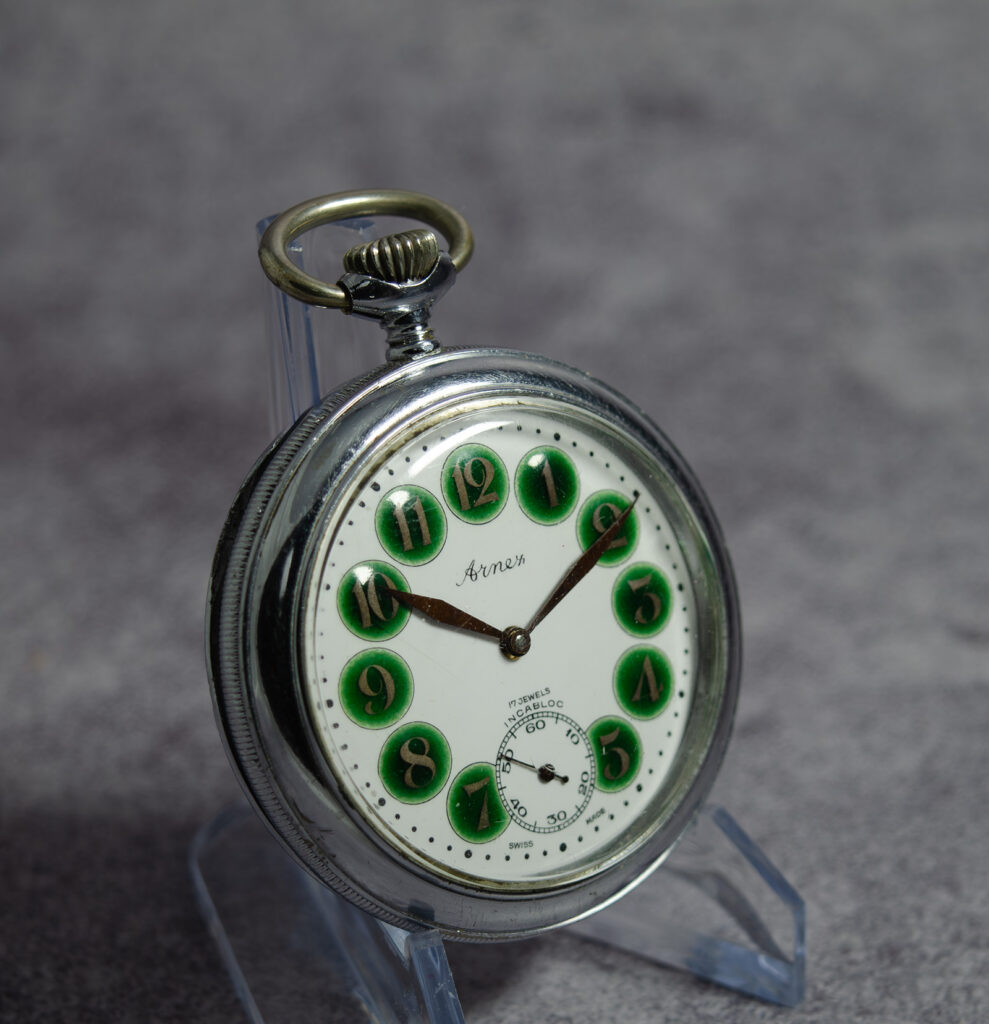
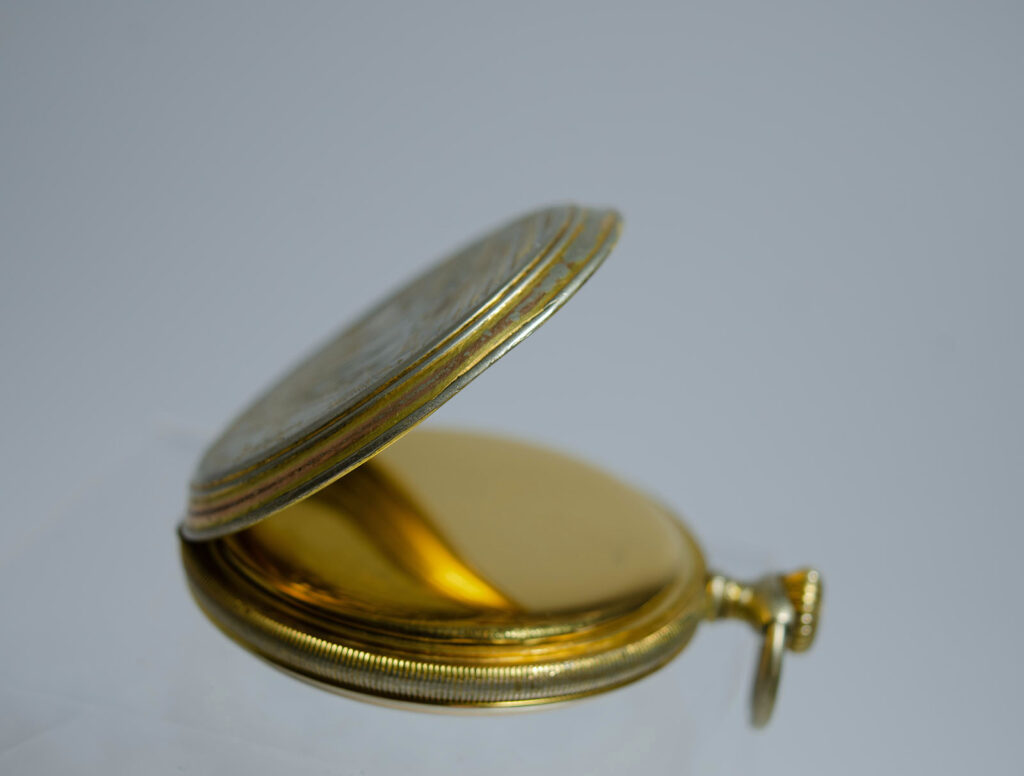
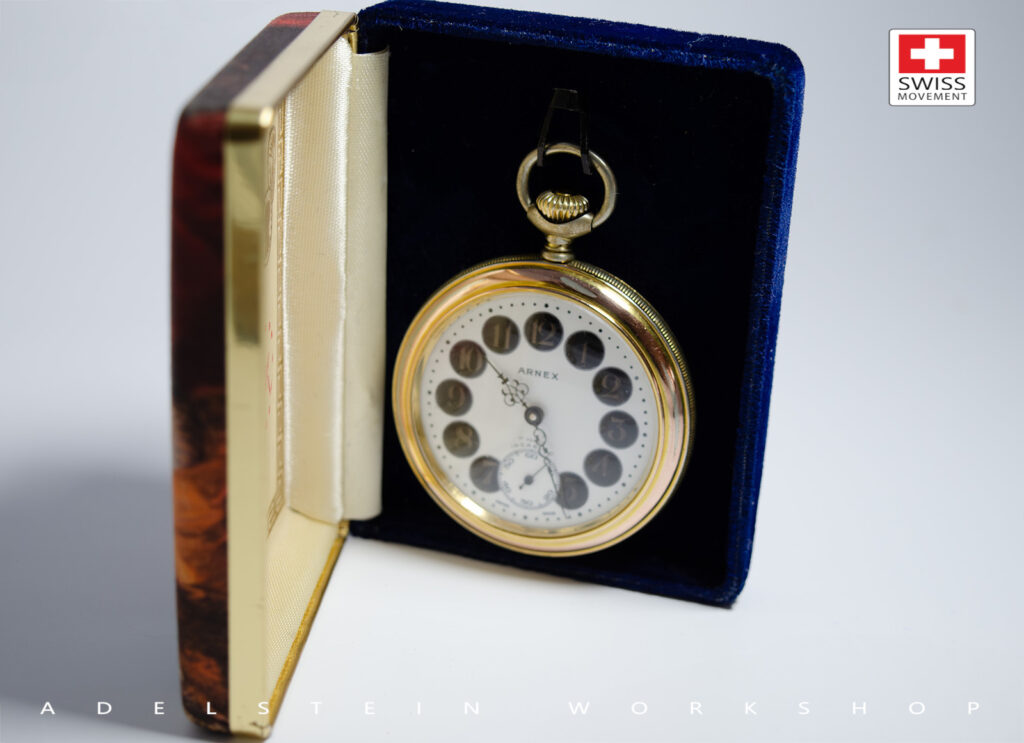
At first glance, this vintage Arnex pocket watch is elegant: a fired porcelain enamel dial with cartouche numerals, a bronze open-face case, and the unmistakable charm of Swiss craftsmanship. But beneath the dial lies something far more intriguing—a Unitas Caliber 431, a rare and historically significant movement that elevates this watch from collectible to conversation piece.
This piece stands apart in a world where Arnex is often associated with mass-market affordability. It’s a mechanical outlier, a survivor from a transitional era in horology, and a testament to the enduring value of thoughtful restoration.
Arnex and the Swiss Export Boom
Founded in 1971 by Arnold Fuchs, Arnex SA was created with a clear mission: to produce affordable Swiss pocket watches for the American market. The company quickly scaled production, offering watches that were stylish, functional, and accessible to nearly every budget.
Arnex watches were often powered by Unitas 6497 movements—reliable, inexpensive, and easy to service. Cases were typically made from base metals, dials from printed metal or acrylic, and crystals from plastic. These watches flooded department stores and gift catalogs throughout the 1970s and early ’80s, making Arnex a household name among casual buyers.
But this watch is different.
Inside the Unitas 431 – Specs and Significance
The Unitas Caliber 431 predates Arnex itself. Produced between the 1940s and 1960s, it was designed as a significant, hand-wound movement for traditional pocket watches. With its 18.5 ligne diameter (~41.7 mm), 17 jewels, and 18,000 bph beat rate, the 431 offered smooth operation and a generous power reserve of ~41 hours.
Unlike the later 6497 and 6498, which became ubiquitous in both pocket and wristwatches, the 431 was produced in relatively low volumes. It lacks modern features like hacking seconds or Incabloc shock protection, but its architecture is clean, robust, and highly serviceable.
Specs at a glance:
Movement: Unitas 431 (manual wind)
Jewels: 17
Beat Rate: 18,000 bph
Diameter: 41.7 mm (18.5 lignes)
Height: 4.7 mm
Functions: Hours, minutes, small seconds at 6:00
Stem: 988L
Country of Manufacture: Switzerland
A Brief Detour—Waltham’s Influence on the Era
To fully appreciate the 431’s place in horological history, we must look briefly at Waltham, the American watchmaking giant that pioneered industrialized timepiece production in the 19th century. By the 1950s, Waltham’s U.S. operations had ceased, and the brand name was licensed to Swiss firms who continued producing watches under the Waltham label.
Some of these “Swiss Walthams” were powered by the Unitas 431, moving a mechanical bridge between American branding and Swiss engineering. While this Arnex isn’t a Waltham, the 431’s presence in both brands underscores its role in a pivotal transitional era.
Why This Arnex Is So Unusual
Arnex typically used the 6497 in its pocket watches—a movement that was cheaper to produce and more widely available. The presence of a Unitas 431 in this watch is highly unusual, suggesting one of two possibilities:
Early Production: This could be an early Arnex model assembled using surplus Swiss movements before the company standardized on the 6497.
Special Batch or Private Label: Arnex often produced watches for other brands. This piece may have been part of a limited run or private-label order that called for a higher-grade movement.
Either way, it’s a rare configuration—and one that collectors are unlikely to encounter again.
Restoration Notes – Preserving the Past
When this watch arrived at our workshop, it was a textbook case of hidden potential. The fired porcelain enamel dial had survived beautifully, with its cartouche-style Arabic numerals still crisp and legible. The bronze case showed honest wear but retained its structural integrity.
The movement, however, needed attention. It was carefully disassembled, cleaned, and reassembled using original Swiss components. The balance was regulated, the mainspring lubricated with modern synthetic oils, and the dial and hands were preserved in their original state. No shortcuts. No compromises.
The result? A fully functional, historically significant timepiece that now ticks with the same rhythm it did half a century ago.
Why Collectors Should Pay Attention
This isn’t just a vintage pocket watch—it’s a mechanical artifact. Here’s why it matters:
Rarity: The 431 is seldom seen in Arnex watches, making this piece a true outlier.
Historical Value: It represents a transitional moment in Swiss watchmaking, when surplus movements met export-driven design.
Mechanical Integrity: The 431 is a joy to service and a pleasure to wind—smooth, deliberate, and built to last.
Aesthetic Appeal: The fired enamel dial and bronze case offer a visual warmth that modern watches can’t replicate.
For collectors, this is a chance to own something that’s both beautiful and historically meaningful.
Ownership & Care
If you’re fortunate enough to own a watch like this, here’s how to keep it ticking:
Winding: Daily, with gentle pressure—stop when resistance increases
Storage: Keep away from magnets and moisture; store dial-up in a soft pouch
Servicing: Every 3–5 years by a qualified watchmaker familiar with vintage calibers
Display: Consider a glass dome or stand to showcase the dial and movement
This isn’t just a watch—it’s a legacy.
Final Thoughts – Time, Preserved
In an era of disposable tech and digital distractions, this Arnex pocket watch offers something rare: tangible timekeeping with a soul. It’s not just about nostalgia—it’s about honoring the ingenuity, precision, and artistry that defined a generation of watchmakers.
At Watchmasters, we don’t just sell watches—we preserve legacies. And this Unitas 431-powered Arnex is one worth remembering.
Now available from US Watch Masters:
This remanufactured Arnex 431 pocket watch is being offered exclusively to collectors via eBay. View the listing on eBay →
This timepiece is not only aesthetically pleasing and of historical importance but also scarce. It boasts a Unitas 431 movement, remanufactured to the exacting standards of Unitas using solely Unitas components. The watch is a substantial 18.5 ligne (41mm) open face (Lépine) pocket watch, crafted entirely in Switzerland during the 1960s, though the inception of the 431 Caliber dates back to the 1940s. This specific model is a featured Arnex watch promoted in their 1972-73 catalog.
Cortebert employed an identical main plate in its 726/736 caliber railroad watch, which was designated for use by the Italian and Turkish railway services. In Italy, the watch was marketed under the Perseo brand, whereas in Turkey, it retained the Cortebert name. Hamilton integrated the Cortebert 669 and 670 movements into their Traffic Special models up until 1969.
Collectors have long speculated whether Ebauches SA facilitated a collaboration between two of its subsidiaries, Unitas, founded by Auguste Reymond, and Cortebert, established by Abraham-Louis Juilliard, through Rolex in the development of the Panerai Radiomir 3646, used by the Italian Navy.
We remanufacture all of our watch movements to like new condition for sale on eBay.
Our mission is to empower watch owners by providing essential tools for their passion. Globally sourcing and meticulously restoring timepieces, we stand as a premier destination for Rolex and other esteemed watch brands’ repair and restoration services.
Lower Your Start-up Costs with Vintage Watch Tools
In 2023, the US Bureau of Labor Statistics estimated that US firms employed about 1800 watch repairers. Compare that number, when the Saint Louis Fed estimated: “Employment of watch repairers at more than 25,000 in 1963.” They also believed, “employment opportunities will continue to be good through the 1960’s and in the longer run for experienced watch repairmen who have established reputations for doing high quality work.”
What Happened?
Of the 1800 watch repairers the US Bureau of Labor Statistics identified in 2023, most worked for manufacturers. A few had their own shops and considered themselves independent contractors accepting work from various jewelry stores and from individuals through the Internet.
“The watchmaking world is facing an unprecedented problem: a severe lack of watchmakers who can build and repair timepieces as well as technicians, engineers and other skilled workers. That has contributed to such severe supply problems that they could stall growth, especially at top-end brands.
“There is a true shortage of manpower,” Aurélie Streit, vice president of the Fondation de la Haute Horlogerie, said during a recent video interview from the organization’s Geneva headquarters. “Not only watchmakers, but also specialists in the 15 other watchmaking jobs, from precision mechanics to engineers, finishers, polishers, research and development,
Who Will Fill the Gap?
In the US and Europe, hobbyists have taken to watch restoring. The evidence exists on watch forums such as watchyouseek.com and in the UK at WatchRepairTalk. YouTube has seen a large influx of watch repair “how to” videos from around the globe. Even
Vintage watch collectors see Kendrick and Davis (K&D) tools as the height of value. because the company revolutionized the repair and service industry with innovations. For example, they invented the Inverto staking frame, canon pinion removers and balance tools. Today, watchmakers like me can use tools K&D made in the early 1900’s especially watchmaker staking tool sets.
The company dominated the market in terms the number of tools sold, and I have their staking tools, bench blocks, balance screw holders and canon pinion removers. Why? I cannot find new tools to accomplish the same tasks.
Before quartz watches and replaceable movements became available, US jewelers and watch companies (like Hamilton, Elgin and Bulova) employed about 65,000 watchmakers. and the United States had robust competitive suppliers called parts houses. Today, only about 1800 watchmakers work in the industry according to Kansas City Federal Reserve Bank. Tool manufacturers just do not find the US market and more.
In the early years, companies innovated, but few made their components backward compatible. Also, documentation doesn’t exist for cross referencing. I searched and found materials for my own use and chose to make them available to my readers.
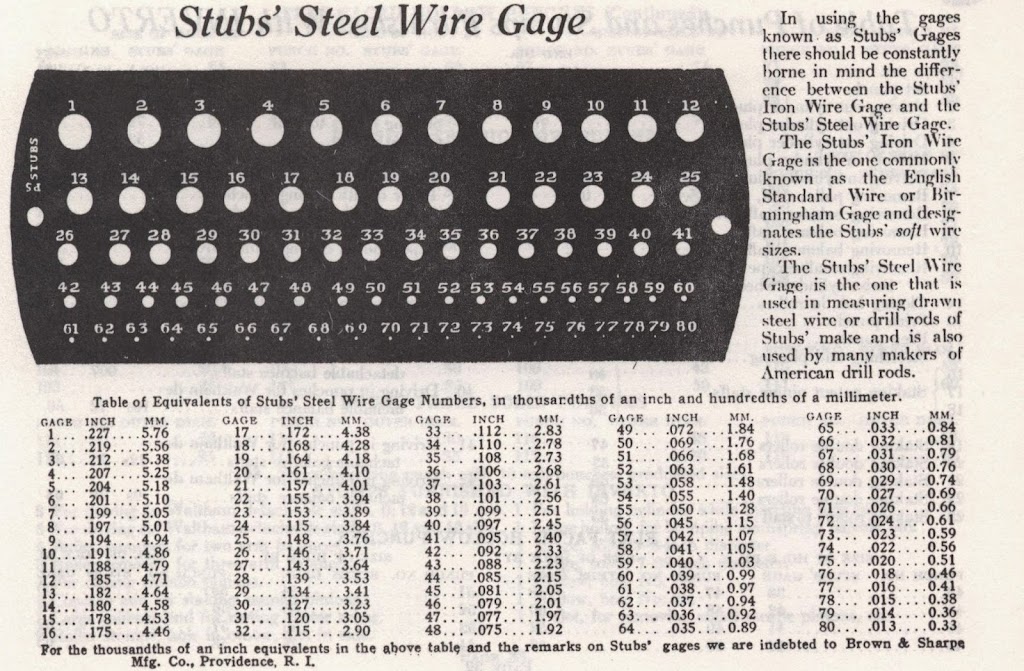
Stubs to Inch to MM conversion chart [click to enlarge]
What’s the size of the stakes in your set?
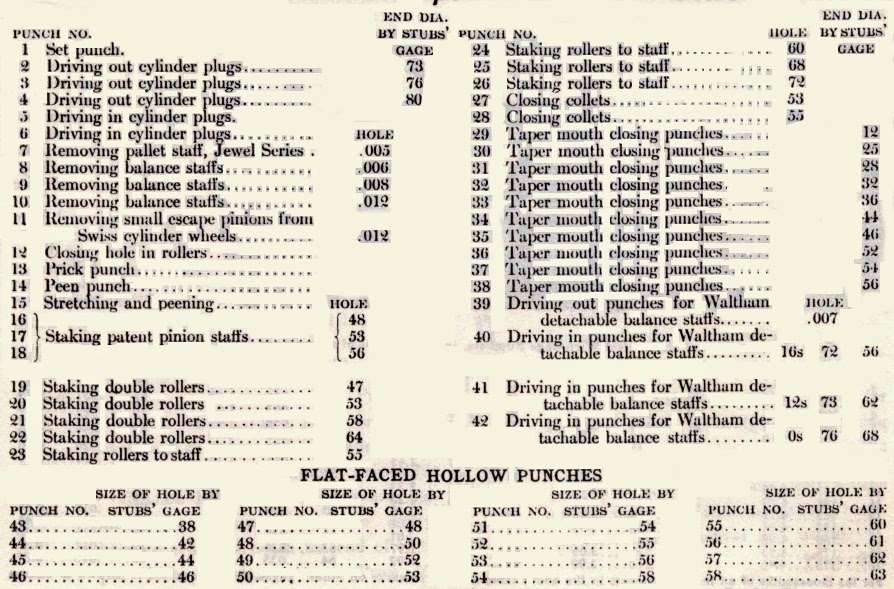
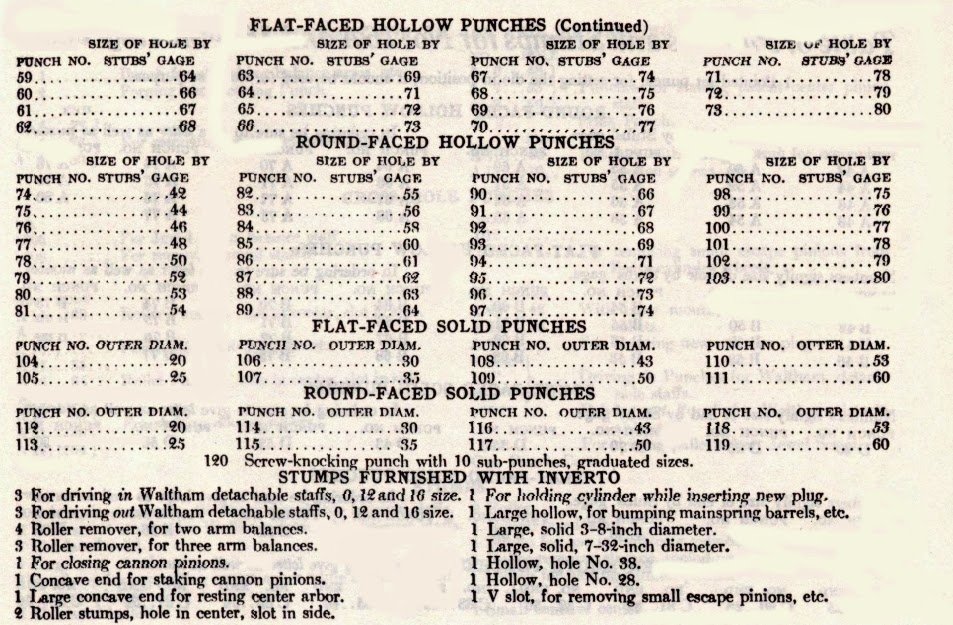
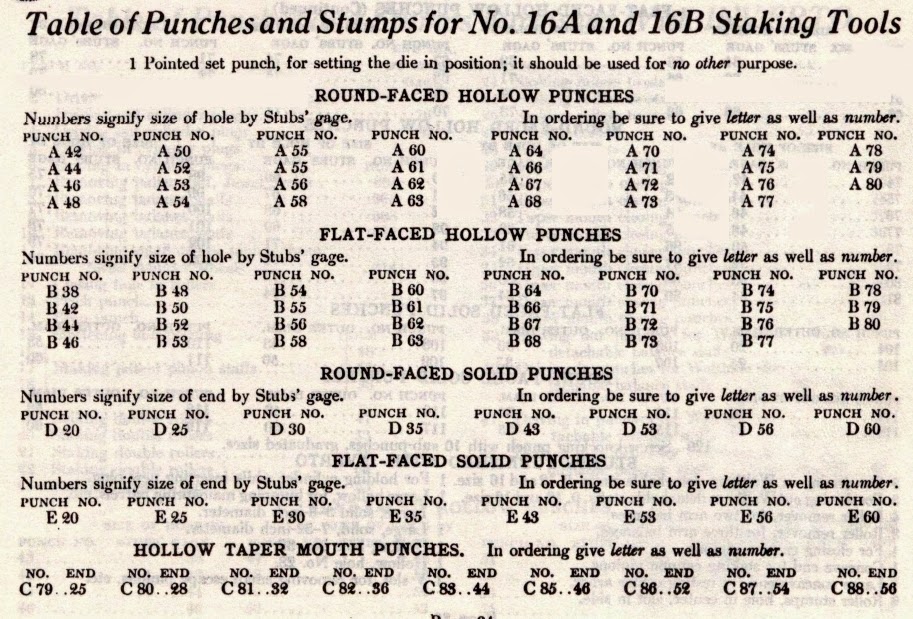
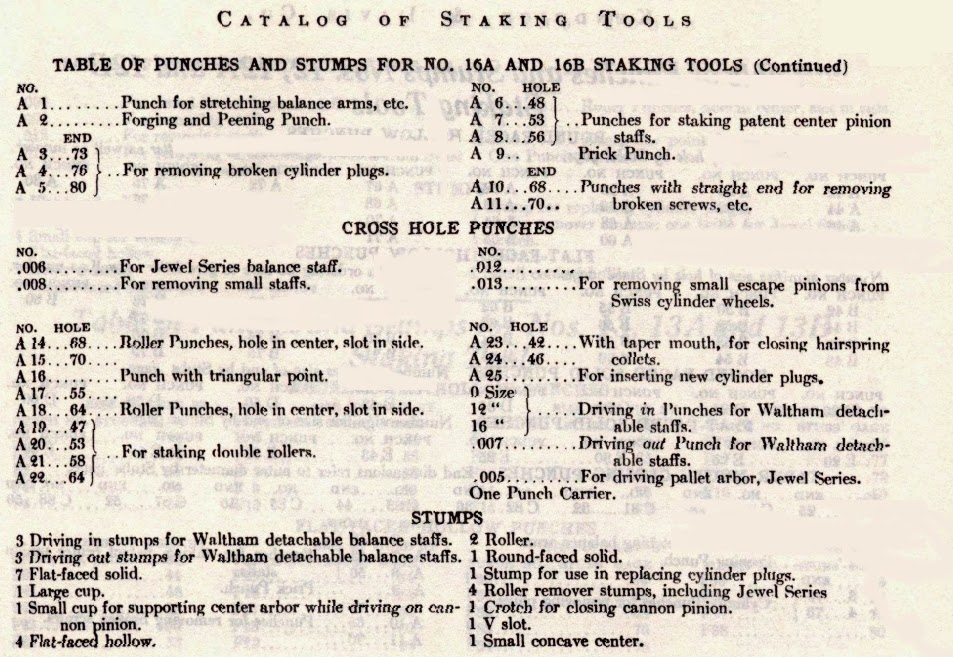
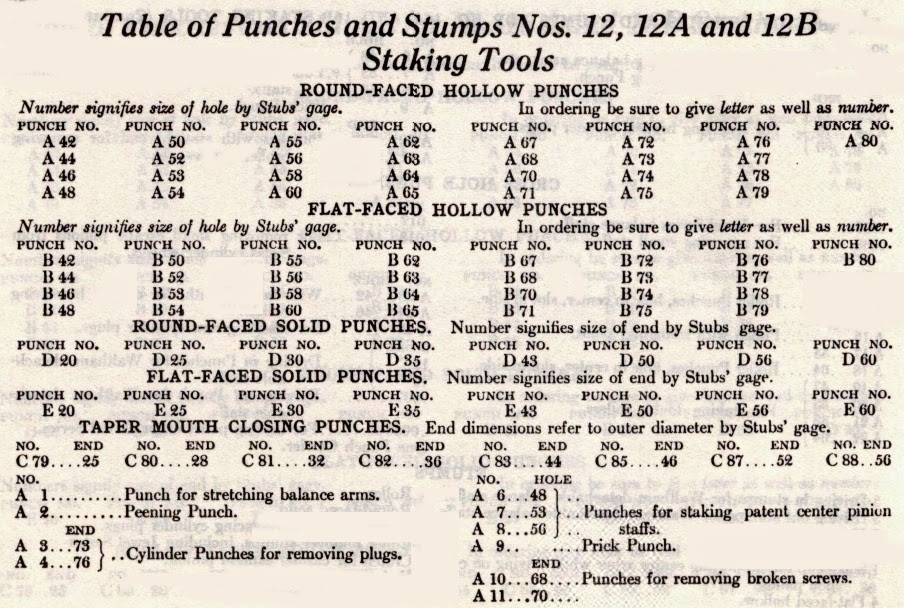
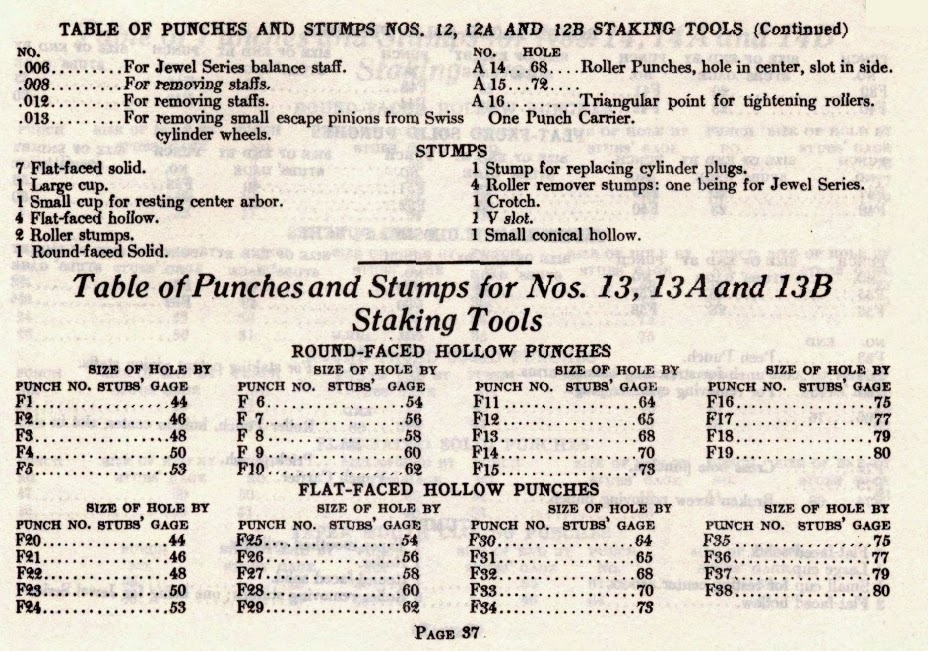
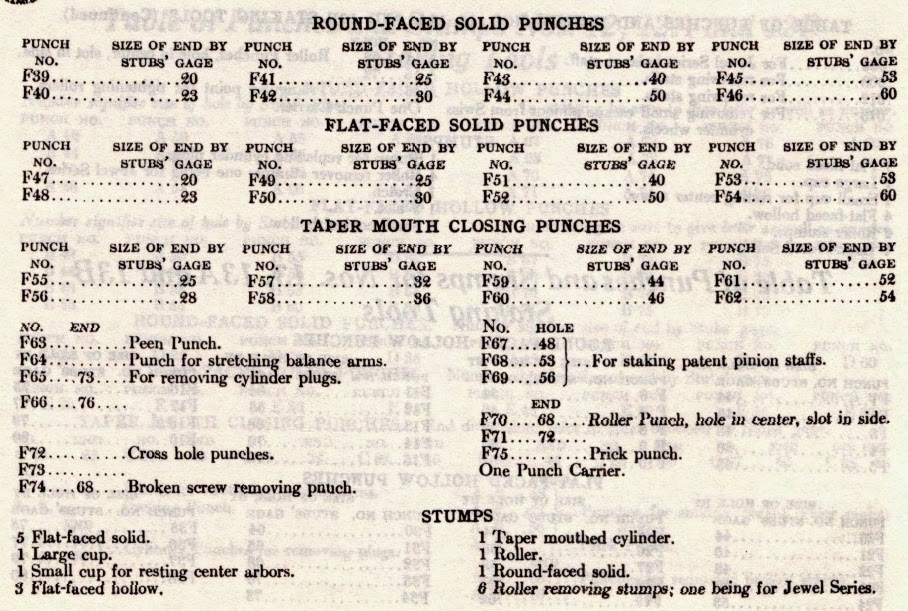
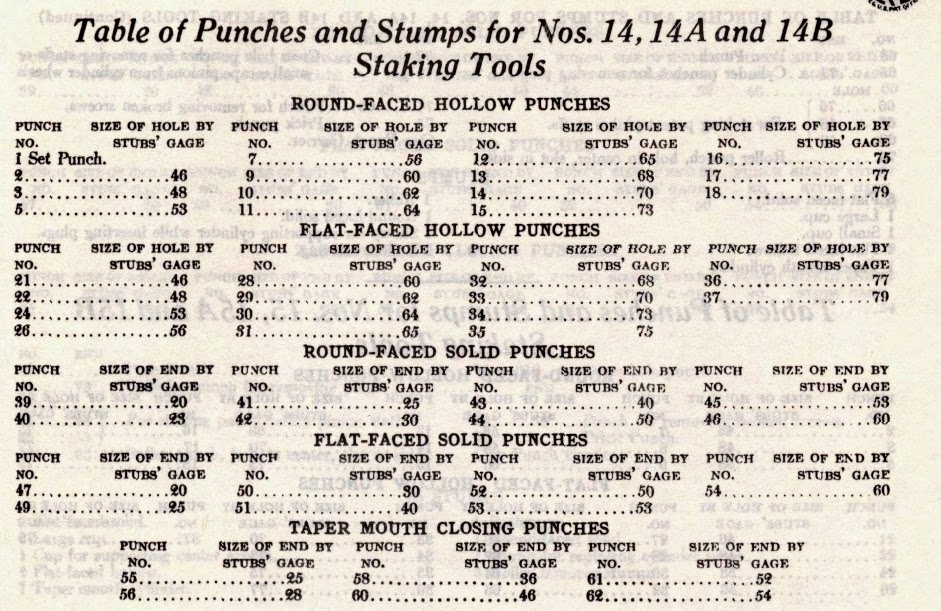
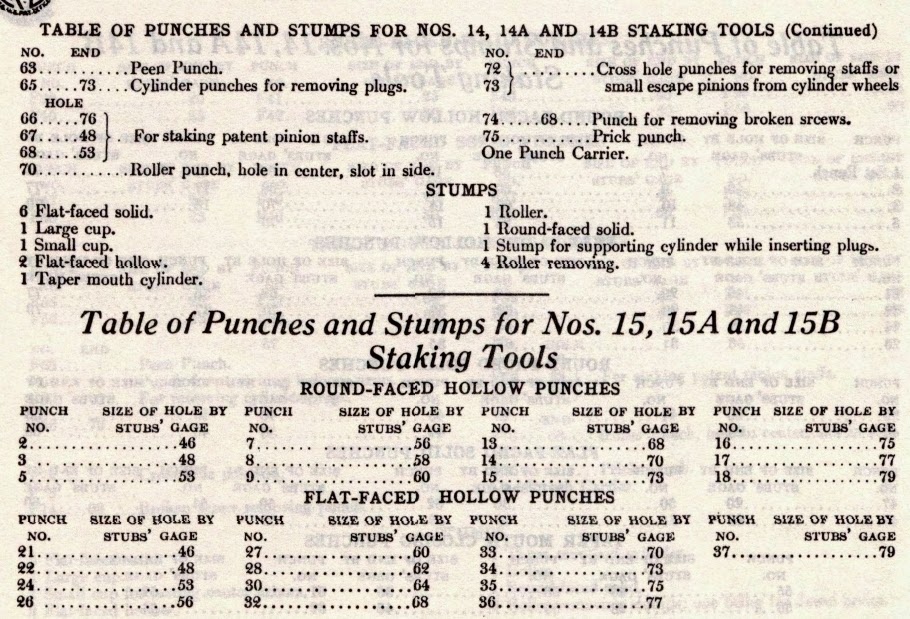
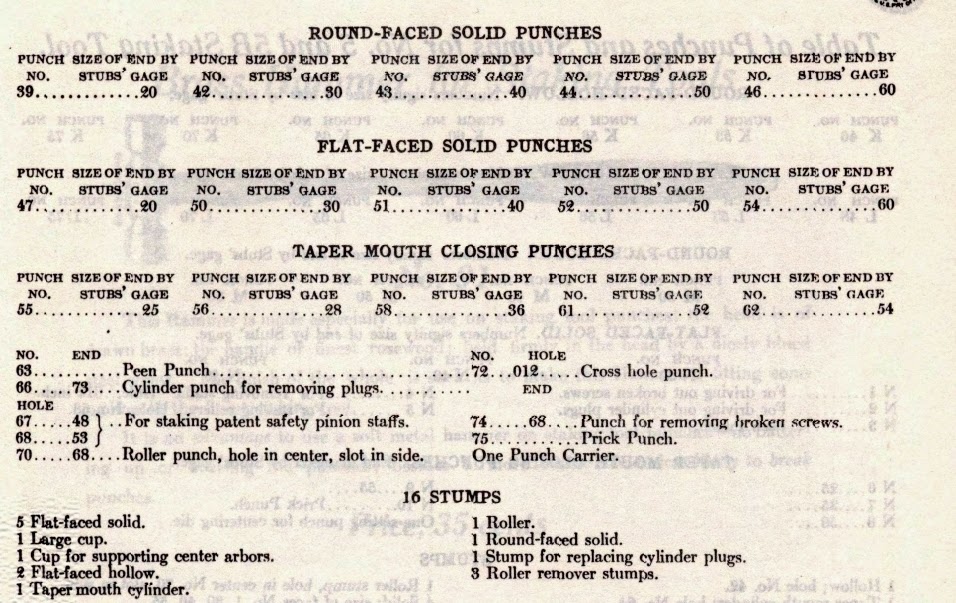
This article exists to provide you with the various reference numbers of staking set punches and stumps made by Kendrick and David for their respective frames and other tools.
Over their 98-year history, the company made only a few models. You can use the information here to make purchase decisions.
I use preowned watch tools. Hopefully, this information will help watchmakers and collectors identify their holdings.
Kendrick & Davis referred to their first staking set as No. 5 and it came with 32 punches and 8 stumps, which they wrote about in their catalog and said that the 5 and 5B were the same as the Hall Staking Tool. It did not have a die binding mechanism or the sustaining friction sleeve.
K & D produced a second model known as the “New Design” but the new design came in five configurations. They included the following:
They bundled the Models 12 -15 with a revolving base or a box and also offered a handle, known as an AH. The Model 16 came later with 120 punches and 30 stumps.
When they changed to their Inverto Models 17 and 18, the frames looked the same as later models having a knurled punch sustainer or knob at the top of the sleeve which secured a punch from moving.
You can find models included the 17, 18B and 18R plus the 600 series still in existence. The box can confuse since most of they have the model 18 on the name plate regardless of what’s inside.
Punches and Stumps
If you buy a staking set, more likely than not, you will find punches of different sizes with different numbering systems. For example, a round face hollow punch with a .045 mm hole might be stamped 83 K&D, A 56 K&D or simply7. Also, those punches can differ in length to fit the frame model from which they came. For example, the Inverto punches have the shorter length.
Another twist in numbering comes with the New Design model frame. Models 12, 13 and 16 use the letter number format (A xx), while 14 and 15 use the Inverto number format (xx K&D).
The company does not make staking sets as of 1998, so anything you buy will be used watchmaker staking tool tets. More likely than not, you will find a mixture of punches with different numbering schemes in your sets. That’s not always the case, but you might want to examine the charts listed below. Focus on the Stubs Chart above. The older punches use the Stubs steel wire measure and later ones use millimeters.
K&D used Stubs Steel Wire gauge to identify the size of the hole in early punches and millimeters in later models. In a some cases, K&D used the same number on different punches.
The stumps also differed according to era. When pocket watches prevailed, the stumps had different shapes and sizes than when bracelets (strap or wrist watches) came into vogue. Inverto sets used different punches than “Specials” and “New Designs”.
In my pile of punches and stumps, I have found other branded ones, especially Moseley, Boley, GF and Swiss Standard. It took a couple of years, but I found some conversion charts for punches and cobbled several charts together.
Back to the company. You find size and type charts for K&D punches and stubs.