Posted on

K&D Kendrick and Davis Balance Staff Remover W/ Directions


This is K&D No. 43-350B. Also referred to as the 50B


K&D bundled this model and its punch with their top of the line Inverto 18R Deluxe Staking sets. They also sold the 50 & 50B components as an accessories..


When you see a “B” next to a K&D product number, you can count on that being for “bracelet” – an older term meaning wrist or strap watch as opposed to pocket watches.

This is a valuable tool for extracting staffs quickly and efficiently. The balance arms are protected against distortion and splitting as long as you use the bundled punch. All parts except the punch are satin chromium plated. The punch is hardened, tempered steel. The 50B, as opposed to the model 50, fits wristwatches only. 

The 43-350B with its accompanying punch, 50B, is difficult to find.
You have to take care in choosing this tool. The sub-punch on the end of the 50B stake bends easily. I’ve seen them sheared off. If you attempt to take the bend out you should have agility working with staking tools. The K&D staff remover is basically worthless without the correct punch with a straight extension and clean hole for the staff. If you don’t have that, the staff will not come out cleanly. You’ll have over banking and end shake.


DIRECTIONS

Select proper hole in Staking Tool die to let hub of staff through: place balance with staff to be removed in same. Set remover over same and insert its pu!1ch through staking tool and
main body of remover. Holding punch in position over.. pivot with finger of right hand tighten knurled remover nut upwards against staking tool arm.

Stop arm of remover will swing against body of Staking Tool and prevent body of tool turning while tightening knurled sleeve. Do not over tighten this sleeve:

it is not necessary. Now strike punch a sharp blow with light hammer and staff will come
out without injury to Balance; riveting of staff simply being sheared off.

NO. 50 BALANCE STAFF REMOVER

In ordering our No. 50 measure the gap between your Staking Tool die and bottom of Goose Neck. Table below will show the size

No. 50 which will fit your Staking Tool.

“K.& D” No. 50 Will fit any S. T. Staking Tools No. Sizes Die Gap of #18 Series #600 Series
1 1-8in. ‘7-8in. 1 3.16in. 1 1-16in.

All the above No. 50 sizes can be furnished for Bracelet size Balances but in ordering add
the letter “B”.

Posted on

Sale Price of 18R Deluxe September 24, 2013


This set went for $331

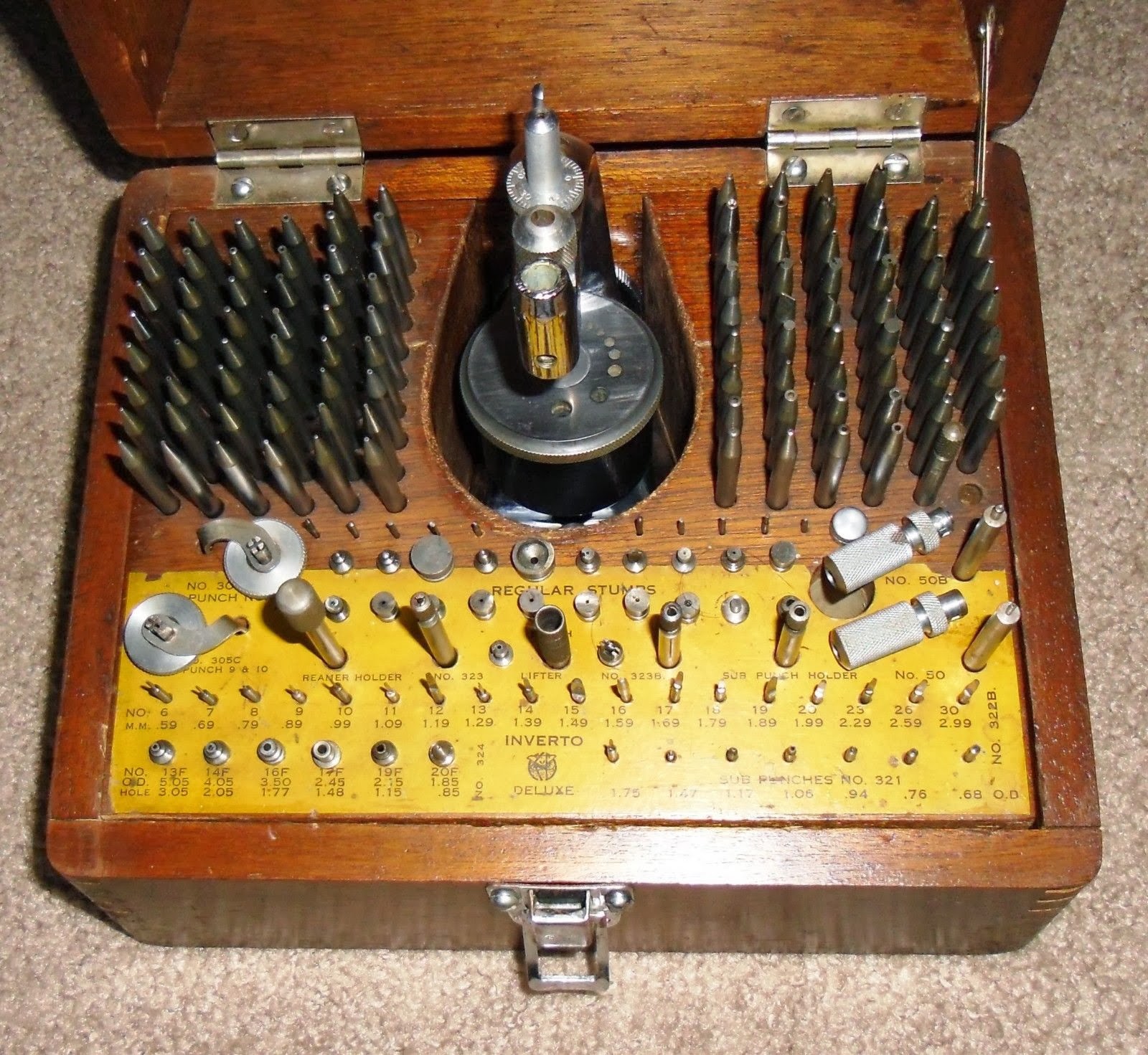
This is a complete K&D Inverto 18R DeLuxe. Most horologists say it is the finest Staking Tool Kit ever made. One could sell the individual components for more than most models of this kit sell for on eBay.


Items included

No. 43-355 & 360 Balance Staff Removers
No. 401-130 Cone Miller
No. 43-118-01 Frame complete with Die Plate, MICROMETER stop and lever
No. 118-03 Wood Box
No. 305 B and 305 C Adjustable Roller Remover Stumps
No. 43-316 10 Sub-Punches and Holder
No. 43-31 7 Jewel Pushers & Holder
No.  322 B 18 Jeweling Reamers & Holder
No. 43 -323 & 323 B Canon Pinion Closing Punches & Stumps
No. 43-324 6 Friction Jeweling Stumps
100 Selected Punches
20 Selected Stumps
The user manual K&D Staking Tools and How to Use Them for the Inverto 18R Deluxe and 18R (23 pages).
The punches are made of hardened, tempered steel with satin finish – easy to maintain. The stumps are made of both hardened and soft steel to accommodate the tools you will need.
The Micrometer Stop lever is useful for any jeweling work you might perform.
The set is reconditioned. For example, maintenance was performed by non-toxic solution-rinsing, hand buffing and oiling each punch. Rinsing and buffing the stumps. Complete over-haul of the frame including cleaning, oil and buffing each component.
Each stake, stump and tools are in the original slots as the set came from K&D. 
If you have looked at newer sets by other manufacturers, you will know that no one has ever made a product this good. 

Posted on

Sale Price of 18R Deluxe – October 30, 2013

This set went for $293.

This is a complete 18-R Deluxe Staking Tool Set with Accessories

Extended Staking Tools
Frame Complete with Die Plate, Micrometer Stop and Lever and handle 43-118-01
100 Customer Selected Punches and 20 Stumps
Balance Staff Removers 43-355, 43-360
Two adjustable Roller Remover Stumps 43-305, 305B
2 Canon Pinion Closing Punches and Stumps 
2 Incabloc punches and 2 stumps No. 20A, 21A and 62, 67
10 Sub-punches and holder 43-316
Jeweling Tools
7 Jewel Pushers and holder 43-321
18 Jeweling Reamers & holder 43-322B
6 Friction Jeweling Stumps 43-324
Cone Miller 43 401- 130
Container
Hardwood Box 43-118-03
The user manual K&D Staking Tools and How to Use Them for the Inverto 18R Deluxe and 18R (23 pages).

This set is complete as configured by K&D for the original buyer. It includes all the items listed in the description above which matches the description of the 43-119 18-R Deluxe Staking Tool Set in the K&D catalog.  K&D made over 150 different punches and over 75 unique stumps, not including those made before 1948. You will not find every punch, for example, listed in the K&D manual in this set as they never sold one with over 100 stakes and 20 stumps at once.  K&D made sets with 30, 60, 80 and 100 punches accompanied by either 10 or 20 stumps. Specifically, the pallet arbor punches and center wheel pinion punches are not shipped with the standard 18R. Also, some punches such as numbers 57 and 87 were discontinued by K&D sometime during the 1940 war years. 
The punches are made of hardened, tempered steel with satin finish – easy to maintain. The stumps are made of both hardened and soft steel to accommodate the tools you will need. Each tool is in its original slot as configured by Kendrick and Davis. I reconditioned this set by solution-rinsing, hand buffing and lightly oiling each punch while rinsing and buffing the stumps; complete over-haul of the frame including cleaning, oiling and buffing each component.  The hardwood box is refinished.
The manual mentioned above explains the steps in Friction Jeweling. You’ll find the 32 components under “Jeweling Tools”, which are equal to or better than those produced by other manufacturers even today. If you choose to use the jeweling capabilities of the 18R Deluxe then you will appreciate the Micrometer setting component and the stop lever.  
About K&D Inverto frames
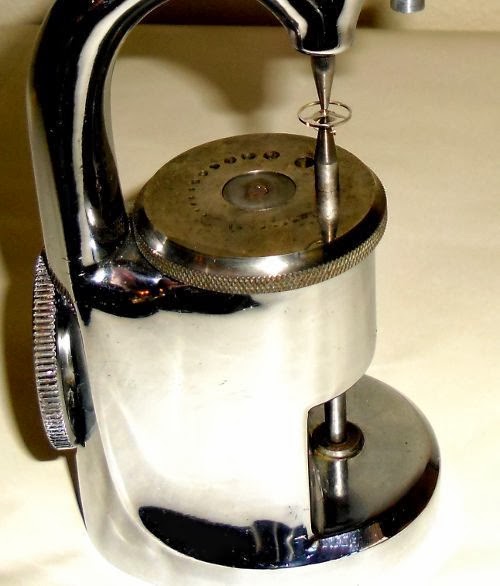
The Inverto principle  allows a stake to slide into the the arm of the tool upside down into the die plate so that only the tip of the stake protrudes above the die plate. Each stake can be used as a stump. With 100 stakes, the Inverto offers 10,000 stake-stump combinations. Photo number 4 illustrates the use of the Inverto capability. Watchmakers use this capability when restaffing or repairing balances.
Shipping weight is 12.5 pounds. Punches are packaged out of their holders, so they won’t spill during delivery. They’re separated by row number and side.

Posted on

Sale Price of 18R Deluxe – November 24, 2013

Sales price at auction: $307.22

This is a K&D Inverto 18-R Deluxe Staking Tool Set and Accessories.


Extended Staking Tools

  • Frame Complete with Die Plate, Micrometer Stop and Lever and handle 43-118-01
  • 100 Customer Selected Punches and 20 Stumps
  • Balance Staff Removers 43-355, 43-360
  • Two adjustable Roller Remover Stumps 43-305, 305B
  • 10 Sub-punches and holder 43-316
Jeweling Tools
  • 7 Jewel Pushers and holder 43-321
  • 18 Jeweling Reamers & holder 43-322B
  • 6 Friction Jeweling Stumps 43-324
  • Cone Miller 43 401- 130
Container
  • Hardwood Box 43-118-03 – In used condition.
  • The user manual K&D Staking Tools and How to Use Them for the Inverto 18R Deluxe and 18R (23 pages)
This set is complete as configured by K&D for the original buyer. It includes all the items listed in the description above which matches the description of the 43-119 18-R Deluxe Staking Tool Set in the K&D catalog.  K&D made over 150 different punches and over 75 unique stumps, not including those made before 1948. You will not find every punch, for example, listed in the K&D manual in this set as they didn’t offer 18R sets with over 100 stakes and 20 stumps at once.  K&D made sets with 30, 60, 80 and 100 punches accompanied by either 10 or 20 stumps. Specifically, the pallet arbor punches are not shipped with the standard 18R. Also, some stakes such as numbers 57 and 87 were discontinued by K&D sometime during the 1940 war years. 
The punches are made of hardened, tempered steel with satin finish – easy to maintain. The stumps are made of both hardened and soft steel to accommodate the tools you will need. Each tool is in its original slot as configured by Kendrick and Davis for the buyer. I examined each tool. I recondition some punches by rising with a non-toxic solution, hand buffing and lightly oiling the punch or stump. If a punch, stump or accessory looks like it has rust or is soiled in the photos, it’s only a reflection. 
The hardwood box is in good condition – structurally sound and made of hardwood. It’s not damaged or dried out. 
About K&D Inverto frames
The Inverto principle  allows a stake to slide into the the arm of the tool upside down into the die plate so that only the tip of the stake protrudes above the die plate. Each stake can be used as a stump. With 100 stakes, the Inverto offers 10,000 stake-stump combinations. Photo number 4 illustrates the use of the Inverto capability. Watch makes use this capability when restaffing or repairing balances.
Shipping weight is 12.5 pounds. Punches are packaged out of their holders, so they won’t spill during delivery. They’re separated by row number and side. No international delivery – Untied States only.

Posted on

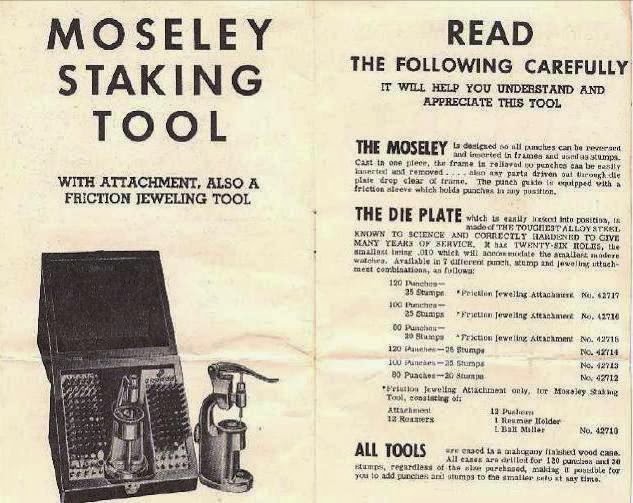
K&D and Moseley Staking Tool Manuals with Compatibility Chart – Downloads

You will probably discover the difficulty in finding staking tool manuals. If you look at the cost of the 1910 K&D book – Staking Tools and How to Use Them, you know people ask a ridiculously high price for this out-of-date book. I believe it’s still the best book available. You won’t sell coverage the the tools and the punches numbers and sizes elsewhere.

I have created a Cross-Over Chart. You can take any K&D number and see it’s corresponding equivalent in Marshall, Boley, Bergeon, Star and so forth. You can download it here.

Cross-Over-Guide Download

Some of us are just getting started so I have provided free downloads of two manuals found on the Internet after weeks of searching. You may download them by clicking on the link.

Good luck to you!

If you want to take a look at what’s available on eBay, here’s another link you will like.

Posted on

K&D Kendrick and Davis Corporation First Inverto by Fred C Myrick, Lester J Williams

Publication number US1045487 A
Publication type Grant
Publication date Nov 26, 1912
Filing date May 28, 1908
Priority date May 28, 1908
Inventors Fred C MyrickLester J Williams
Original Assignee Kendrick & Davis Company
Referenced by (1), Classifications (6)
External Links: USPTOUSPTO AssignmentEspacenet
Inverto #1

DESCRIPTION OCR Text Contains Many Errors and Corrections are on-going.
L. J. WILLIAMS & F. G. MYRIGK.
Patented Nov. 26
O 0 0 E2 /.7W/ f 1 D 0/ n COLUMBIA PLANOGRAPH c0., WASHINGTON, u. c.
FQE.
LESTER J. WILLIAMS, OF LEBANON, AND TRIED G. MYBIGK, OF MANCHESTER, NEW HAMPSHIRE,
LASSIG’NOB/S TO KENDRICK &DAVIS COMPANY, OF LEBANON, NEW HAMPSHIRE,
A CORPORATION ‘OF NEW HAMPSHIRE.
STAKING-TOOL.

Specification of Letters Patent.
Patented Nov. 26,1912.
Application filed May 28, 1908. Serial;No.1435,531.
To all whom ,it may concern:

Be it known that we, LESTER J. lVlnnn-mrs and FRED O. MYRIoK, both citizens of the United States, residing, respectively, at Lebanon, in the county of Grafton and State of New Hampshire, and Manchester in the county of Hillsboro and State of New Hampshire, have invented certain new and useful Improvements in Staking-Tools, of
desired position.-
A further object of the invention is to provide a staking tool embodying a holder forming-a part of the tool pro-per adapted to be slidably mounted in a bearing in the eccentric, and provided with a simple friction device, which will engage the said bearing and retain the holder in any desired position.
A still :further object is to provide a stak ing tool wherein the pivot for the die will be so constructed and arranged as automatically toeject one member of the said pivot when it is released from the other, thus simplifying the removal of the die.
A still further object is to provide a staking tool wherein the base will be adapted to receive any of the tools suitable for use-as a stump and support same vertically indepently of the die, thus avoiding the necessity for use of the flange now commonly used instumps, and permitting the use of theordinary tool or stake as a stump.
A still further object is to provide a staking tool wherein said opening in the base will be provided with an ejector plunger adapted to form an anvil base for the. stump, which means will be so constructed and arranged as to becapableof being locked when said plunger is serving as an anvil and be permitted to springupwardly and eject the stump When it is desired to remove same.
And a still further object is to provide a staking toolemploying such a stump ejector wherein the opening in the die adapted to receive the stump will be provided with a friction device to act as a brake upon the stump when 1t 18 removed by such ejector mechanism.
The invention consists in the novel fea– our invention, having portions thereof broken ,away to disclose the structure and the base die, ejector mechanism and holder. Fig. ,2 ,isa sectional view on the line 22 of Fig. 1. :Fig. 3 is a plan view of the die. ig. 4 isa section on the line 4-l-of Fig. 2. Fig. 5 is a detail view of a tool or stake.
Fig. 6 is a verticalsection on a large scale of the lower end of a tool-holder showing a tool therein. Fig. 7 ,is a detail view of the locklng.eccentricfor the die. Fig. 8 is a section on the line 88 of Fig. 7. Fig. 9 is adetail viewof the locking collar for the die. Fig. 10 is a section of amodified form of friction device for the holder, said view being on a much enlarged scale; and Fig. 11.
is a detailed view of one of the friction sleeves employedin the friction device shown in Fig. 10.
Like letters refer to like parts throughout the several views.

In the embodiment of our invention shown in the drawings, A denotes a base carrying .a gooseneck B supporting a vertical bearing C for the tool-holder. ranged eccentrically of the base A and in This bearing is arvertical alinement with any opening in the die D, which is rotatably mounted on said .baseA. is old and Well known in this art, the inven- This general arrangement of parts tion residing in other features of construction utilizing these broad features.

In our present invention we mount a holder a 1n the bearlng C, whlch holder 1s used .as a part of the tool proper and 1s adapted to receive and retain any short tool or stake in the lower end thereof. The use of a holder common to all the’tools or stakes not only reduces the cost of the material in the set of tools, but also of the labor required to produce same.
The holder a, as shown in Fig. 6, has its lower end drilled centrally thereof, as at a, the diameter of the base being sulficient to receive the shank of any tool designed for use therein. Seated in said base is a plug (1 provided with means adapted to engage a tool, such means being preferably a split pin a adapted to enter and engage an opening in a tool. This plug or seat with the split-pin is forced into the holder and is fitted tightly therein, and always remains in the holder. The elongation of the plug a? affords suflicient bearing surface to hold the tool firmly, and the shoulder a on said plug adjacent to said pin forms a solid hammer head adapted to engage the tool. This split-pin and that part of the plug a between the split-pin and the shoulder a fitthe opening in all the stakes nicely so that i the stakes have a bearing inside as well as outside. This construction is more rigid and durable than if the tool were only sup– ported by the walls of the opening in the holder.
In use, it is necessary to watch the work on the die, and to frequently remove the tool therefrom. To avoid the labor and inconvenience of removing the holder a from the bearing C each time it is desired to in spect the work, we provide the said holder with a friction device adapted to engage the bearing G and sustain said holder in any position in which it may be left. In the preferred form of the invention, this device consists of a tube 6 having its ends closed partly upon the friction balls I), b, which balls are separated and pressed against the bearing C by a spring 6 It will thus be seen that the balls I) are normally pressed outward by the spring 6 with sufficient force to sustain the weight of the holder a and any tool contained therein. By applying the friction device to the holder (0, we materially simplify the construction of the tool and reduce the cost of production while giving absolute reliability to the device.
In the modification shown in Figs. 10 and 11, instead of employing a friction device, such as above described, we use two nipples a, a, a portion of each of which is reduced so as to fit the other, and the end of each of which is closed and rounded so as to project into engagement withthe hearing C. The reduced portion has an elongated slot therein, as 0 a pin a passing through the holder a, and said slots serving to hold said device in the holder and per– mit that slight lateral movement necessary to mount the holder in the bearing C. These tubes are pressed outwardly by a spring 0, mounted within them. As it is necessary to hammer the holder a, and when the said holder is common to a number of tools it is desirable to avoid wear thereon as much as possible, we provide the holder or with a hardened steel top peg d projecting beyond the body of said holder and fitted nicely thereto.
The die D is pivotally mounted upon the base A by means of a collar 6 having a screw-threaded stem 6 adapted to be engaged by a screw-nut 6 the head of which enters a countersink in the said die.v To
facilitate the substitution of dies, we mount a spring 6 between the screw-nut e and the screw-threaded stem 6 so that, as the nut e is unscrewed, the spring 0 will force it upwardly away from the collar 6; this spring 0 also serves to hold the adjustment of the clamping mechanism of the die D so that it will not change when the die is revolved. Passing through the base A is a spindle ‘f having a reduced portion f at some point thereof, and a lever-handle The reduced portion f is arranged eccentrically of the spindle f’ so that by turning said spindle, the said portion f will act as a cam to draw down or raise the collar 6 011 nut e to bind or release the die D. The reduced portion f forming the cam forms oppositely disposed shoulders f adapted to engage the collar (2 and prevent the removal of the said spindle.
The die D, shown in Fig. 3, is of the usual and well-known construction, having a plurality of graduated openings therein to adapt the die to difierent classes of work. The opening (2 through the base .A, in which the collar 0 and screw-nut e are seated, extends entirely through the base so as to allow that vertical movement of these parts necessary to accomplish the clamping of said die against the upper face of said base. Extending through thebase A on a radius the same as that of the various die openings, is a vertical opening 9, in which is seated the stump supporting and ejecting mechanism. This mechanism comprises a cylindrical plunger h, capable of i vertical movement in the opening 9 and normally pressed upwardly by a spring 2′ bearing on the under side thereof, and passing through an adjustable stop screw j. The bottom of the opening 9 is closed’by a set-screw 7a, which serves to hold the spring 2′ in place, and acts as a set-screw relative to the screw j. To overcome the tension of the spring, 5 when a stump is being used in the tool, I provide locking means for the plunger h and preferably make said locking means automatic so that the mere positioning of the V preferably concaved. Passing through the 7 base. A is a cylindrical bore of a diameter with the plunger h.
substantially the same as that of the concave channel it, and seated in said bore is a spindle in having a reduced portion in adapted to enter said channel it and a screw-threaded end m of a smaller diameter than the portion m; an operating handle n mounted upon said set-screw end m and a spring 0 seated between a spring-seat 1) formed in the base A and the said operating handle a, which handle is in the form of a push-button. The spring 0, it will be observed, acts to normally project the handle a and bring the portion m into engagement A similar shoulder q is formed within the bore in a relation to engage the spindle m and limit the extent of projection of said spindle and the parts carried thereby by the spring 0.
In Fig 1 of the drawings, we have shown one form of tool or stake, and in Figs. 2, 5, and 6, other forms of such tools orstakes, all having this similarity in their construction, to wit,that one end thereof has a bore therein of a diameter adapted to fit over and be engaged bythe retaining means, as the split-pin a carried in the holder (1. This feature is present irrespective of the character of the work-end of the tool, although in some tools as that shown in Figs. 2, 5, and 6, this bore extends entirely through the tool axially. In each of the figures, we have indicated the tool at E, and the bore thereof at E. The large opening D in the die I) is especially adapted for use with stumps, and we, therefore, to prevent the ejector mechanism from throwing the stump entirely from the die, provide said opening with a friction ring D The plunger 2., screw and set screw are each provided with a central longitudinal opening, which openings are concentric with each other and concentric with the opening in the bearing C whereby a continuous channel is provided from top to bottom. This construction permits the small watch parts, staffs, pins, etc. to fall down through after being driven out. We provide the base A with a screw-threaded socket in which a key F, adapted to actuate the screw-nut 6 may be screwed, to conveniently attach said key to the tool.
The operation of the herein described staking tool is substantially as follows: The desired tool or stake E being selected, it isinserted into the holder, over the splitpin a and pushed up against the seat a the split-pin a acting as a frictional device to hold the tool or stake in place. The holder a is then inserted in the bearing C, the spring 6 in the preferred form of friction device, or c in the modified form, yielding sufliciently to permit the balls Z) or the sleeves c to recede within said holder sutliciently to permit the holder to be so inserted and subsequently exert that out ward pressure necessary to sustain the the opening 9 and bearing C.
weight of the holder and tool by frictional engagement with the inner surface of said bearing. The die D is then turned until the desired opening therethrough is alined with Thereupon, the spindle j is turned about 45 degrees by the lever handle 7, theecce-ntric portion f thereof drawing the collar 6 and screw-nut e downward and clamping said die against the base. lVhil-e the friction de vice in the holder awill sustain the holder in any desired position in the sleeve or hearing A, the spring therein will not exert sufficient pressure to prevent the free movement of the holder in either direction, so that the holder and the tool or stake carried thereby may be brought down upon the work or raised therefrom for purposes of inspection as required. hen raised, the holder may be released, the friction device holding it in the raised position so as to permit both hands to be used for shifting the work, or substituting one part for another on the die I). The top peg d, being fitted snugly to the top of the holder, will stand all of the blows in the use of the tool without spreading,
thus increasing the life of the holder and avoiding any necessity for tempering theentire holder, and those lnaccuraci-es resulting from such. When it is desired to change a tool, it is merely necessary to re- 7 move the tool or stake E from the split-pin a and substitute another tool therefor. Many of the tools or stakes may be used as stumps, also, if desired, thus making it possible to have a full set of tools and stumps with a much smaller number of parts than is required when the tools and stumps differ essentially in their construction as is the case in the usual and well-known style of staking tools. To use any tool or stake E as a stump, it is merely necessary to bring the opening D of the die I) into alinement with the opening 9 and bearing C and clamp the die in position and insert the tool or stake through said openings until it engages the plunger 7L and thereafter forcing said plunger downwardly until the channel h is alined with the spindle m. The spring 0 will, when the parts are so positioned, force the reduced port-ion m into said channel and lock the plunger in this position. After the die has been clamped as above stated any number of stakes or tools can be used one after the other without changing the position of the die. While, if desired, the spindle m may be relied upon to absorb any shocks upon the plunger h from the stump, we prefer that the parts be adjusted sothat all the shocks will come upon the plunger h, the screw j and set screw k. The locking action of the spindle m is entirely automatic. lVhen it is desired to remove the stump, the operating handle or button is pressed inwardly against the tension of the spring 0, forcing the portion m out of the channel it and permitting the spring a to raise the plunger 7L and with it the stump. The friction ring d will prevent the stump flying entirely out of the die and the plunger h will be retained in its bearing through its engagement with the bottom of the die D. The spindle m will be held preparatory to its next operation through the engagement of the portion m with the plunger 72, below the channel h. The set-screw 76 looks the stop-screw j and acts as a seat for the spring 2′.
It will be observed that by using tools or stakes and stumps having long stems, sutlicient bearing surfaces are provided to secure the desired accuracy in the tool, and also avoid special flanges to absorb shocks on the stumps by transmitting them to the die D. This feature assumes considerable importance in a tool wherein extreme accuracy and precision is an essential feature.
It is not our intention to limit the invention to the details of construction shown in the accompanying drawings, it being apparent that such may be varied and still retain all of the essential characteristics of our invention as defined in the following claims.
Having described the invention, what we claim as new and desire to have protected by Letters Patent is
1. In a staking tool, the combination with a base, a die having an opening therein mounted upon said base, and a bearing alined with the opening in said die, of a tool holder slidably mounted in said hearing, having openings in the opposite sides thereof, laterally movable friction members mounted in said openings and adapted to project beyond said holder and frictionally engaging the inside of said bearing and aspring disposed in said opening between said members whereby said members are forced into engagement with said bearing.
2. In a staking tool, the combination with a base, a die and a bearing of a holder carrying a tool or stake mounted in said bearing, a sleeve having reduced ends carried by.
said holder, a plurality of friction balls mounted in said sleeve and projecting in part through said reduced ends thereof, and a spring projecting said balls from said sleeve.
3. In a staking tool, the combination of a base having an opening therein, a die, means rotatably mounting said die on said base comprising a collar carrying a screw, a screw-nut adapted to engage said die and said screw, and a spring between said collar and said screw-nut, an eccentric mounted in said collar, and an operating handle for said eccentric exposed exteriorly of said base, whereby said die may be locked against said base.
4:. In a staking tool, the combination with a base, a die, a bearing and a. holder carrying a. tool or stake mounted in said hearing, of a stump retaining and ejecting mechanism comprising a plunger seated in an opening below said bearing, a spring acting to normally raise said plunger, a seat for said spring and means whereby said plunger maybe locked when depressed, and released, as desired, to eject a stump from said openmg. 7
In a staking tool, the combination with a base, a die, a bearing and a holder carrying a tool or stake mounted in said hearing, of a. stump retaining and ejecting mechanism comprising a plunger seated in an opening below said’bearing, a spring acting to normally raise said plunger, a seat for said spring, a laterally removable locking member adapted to engage said plunger when it is depressed, and a spring acting on said member whereby it will automatically engage said plunger and said locking member may be reciprocated against the tension of said spring to release said member.
6. In a staking tool, the combination with a base, a die, a bearing and a holder carrying the tool or stake mounted in sald bearing, of a stump retaining and re ect1ng mechanism comprising a. plunger seated in an opening below said bearing, a spring acting to normally raise said plunger, a seat for said spring, said plunger having a hori zontal channel thereabout, a laterally extended spindle mounted in said base, said spindle having a reduced portion adapted to enter said channel, a screw-threaded stem, and an operating’handle or button exposed exteriorly of said base, and a spring acting upon said handle or button, whereby said spindle will be automatically reciprocated to lock said plunger in the depressed position, and said spindle may be reoiprocated to disengage said reduced portion from said channel.
In witness whereof, we have hereunto affixed our signatures in the presence of two witnesses this 23rd day of May, 1908.
LESTER J. WILLIAMS.
FRED C. MYRIGK.


Witnesses:
CHARLES E. Fosrnn, HARRY T. Loin).
Copies of this patent may be obtained for five cents each, by addressing the Commissioner of Ilatents, Washington, I). C.

REFERENCED BY
Posted on

K&D Kendrick and Davis Watch-hand remover

Publication number US922096 A
Publication type Grant
Publication date 18 May 1909
Filing date 24 Dec 1907
Priority date 24 Dec 1907
Inventors Frank R Cunningham
Original Assignee Kendrick & Davis
Referenced by (7), Classifications (1)
External Links: USPTOUSPTO AssignmentEspacenet
DESCRIPTION  (OCR text may contain errors)
Patented May 18, 1909.
UNITED STATES PATENT OFFICE
FRANK R. CUNNINGHAM, OF MEDFORD, MASSACHUSETTS, 
ASSIGNOR TO KENDRICK & DAVIS, OF LEBANON, NEW HAMPSHIRE, A FIRM.
WATCH-HAND REMOVER.
Specification of Letters Patent.
Patented May 18, 1909.
To all whom fit may concern:
Be it known that I, FRANK R. CUNNINGHAM, of Medford, in the county of Middlesex and State of Massachusetts, have invented certain new and useful Improvements in Watch-Hand Removers, of which the following is a specification.
This invention relates to tools for removing the hands of watches and clocks from the arbors on which they are placed, and has for its object to improve tools of this character by providing a centering and retaining device for more readily locating the hand removing jaws and for preventing loss of the hands after their removal.
The invention therefore consists in a tool of this character having a yielding hand retainer and jaw-centering device associated in combination with the other operative parts whose function is to pull the hand from its arbor.
The invention also consists in improved details of construction of the tool which enable the hand-retainer and jaw-centerer to be applied in connection with the other parts of the tool.
Of the accompanying drawings, Figure 1 represents an elevation of the tool in its normal inoperative condition. Fig. 2 represents a similar view, showing the removing jaws separated, preparatory to being inserted beneath the hub of a watch-hand. Fig. 3 represents a sectional elevation on an enlarged scale, showing the tool engaged with a watch hand preparatory to drawing the same from its arbor. Fig. 4 represents a sectional elevation, showing the position of the parts of the tool at the end ‘of the hand removing operation.Figs. 5 and 6 represent details of parts of the tool.
The same reference characters indicate the same parts in all the gears.
The tool consists of a handle and operating rod, hand-removing levers, and associated parts. The operating rod by passes through the handle and both the rod and handle are movable with respect to each other. To the lower end of the handle is removably attached by screwing, a hub or head, which has slots in its opposite sides wherein enter links, which are united to the hub by pivots These links also pass into slots in the upper or outer end links into line portions of the levers c and are pivotally attached thereto by pins g.

For purposes of construction and convenience in assembling, the operating rod is made in two parts, of which the lower part is represented by b and is united with the upper part by a screw-threaded stem b2. The lower end of the rod section b has lugs between, which enter, and are held by pins, links. The lower ends of the latter enter slots in the levers c in which they are held by pins 7c. The lower ends of the hand removing levers below the pins are thinned so as to provide sharp-edged jaws which can enter between the upper surface of the dial of a watch and the hand.
On their adjacent sides above the jaws, the levers are concave so as to provide room for the eye or hub of the hand, while on their outer faces the levers are convex, providing shifting fulcrum points upon which the levers bear when pressure is applied to their upper ends.
When the tool is not in use and all the parts are in equilibrium, it has the appearance shown in Fig. 1. This position of the parts is produced by a spring Z interposed between a shoulder at the lower end of the upper part of the operating rod b, and a sleeve, which surrounds the lower section t of the operating rod. This spring forces the sleeve downward and causes it to exert its pressure on the links y outside of their pivots. Thereby, the swinging ends of the links are impelled toward one another, drawing the jaws together and at the same time drawing the pivotal connections g inward, raising the handle a and tending to draw the levers c. This tendency is resisted, however, by protuberances n on the links which bear against a sleeve o projecting downward from the head d. Thus the links and hand-removing levers are always inclined slightly outward.
In using the tool, the handle is grasped between the thumbvand middle finger, and held vertically over a watch which is placed face upward. The operating rod is then depressed, it having angler-piece t3 which enables the forefinger to actuate it. This pressure of the rod acting downwardly on the link y causes the jaws to be separated sufficiently to impress the hand arbor of the watch. Then the pressure is removed from the rods, the jaws are drawn by the spring Z into the space between the watch-hand and dial against the arbor. The handle a is then pressed down, which imparts a downward pressure through the links e to the outer ends of the levers c. The latter are then caused to turn about the curved fulcrum surfaces c, raising the jaws with a powerful leverage, and prying the ends from the arbor. 
The point of tangency at which the curved surface on the outer end of each lever bears on the adjacent supporting surface of the watch or’clock, constitutes a shifting fulcrum about which the lever turns in removing the watch hand. That portion of the lever extending between its extreme end and the shifting fulcrum point is the short arm of the lever, and it is shaped somewhat as a jaw. As the action of these short lever arms in removing a hand is a prying action, I term the end portions of the levers prying jaws or prying arms.

In tools of this character hitherto used, great difficulty has been experienced in preventing loss of the hands after their removal from their arbors, As after removal from its arbor va hand is only supported on the jaws at one end,its projecting end tends to overbalance it and cause it to drop from the jaws always causing inconvenience and sometimes loss. By my invention, I have provided a retainer which presses against a hand held by the jaws and continues to maintain it in contact with the jaws until it can be deposited where required. rI`his retainer consists of a baror rod p having a head on its lower end, and partly contained within a central chamber of the lower operating rod section b. Between the end of the bar and the end of the chamber is a spring g tending to press the head of the retainer against the jaws or against a hand supported upon them. Total ej ectment of the retainer bar when the jaws are separated is prevented by a pin r passing through the bar into slots s in each side of the operating rod, said pin being prevented from passing out oi’ the ends of said slots by the links j. In order to permit the presence of the presser rod, these links are separated from-one another and pivoted by separate pins, but they are not far enough apart to allow the detent pin r to pass between them. In order to apply the pressure of the operating spring Z to the links at some distance from the pivots of the latter, and thereby obtain sufficient leverage for the purposes required, the links are widened at their upper ends to provide curved protuberant corners y, and between the lower end of the sleeve m and the upper ends of the links is an annular disk t which has its bearing on the links a considerable distance beyond the outer circumference of the sleeve.

I claim:
 1. A tool for removing the hands, a handle, an operating rod movable longitudinally through the same, hand-removing levers having cooperating prying arms, connections from said levers to said handle and rod, and a retainer cooperating with said arms for holding the hand alter removal from the arbor.
2. A watch-hand-removing tool, consisting ol’ cooperating levers having prying jaws adapted to be inserted between the hand and dial of a watch, a handle to which said levers are linked and by which they are operated to pry the hand from its arbor, and a yielding presser arranged to bear on said jaws and hold the hand upon the same.
3. A watch-hand-removing tool, consisting of cooperating levers having prying jaws adapted to be inserted between the hand and dial of a watch, a handle to which said levers are linked and by which they are operated to pry the hand from its arbor, and a yielding presser arrangedly between said levers and above said jaws to bear against the latter and hold the hand thereon after its removal from the arbor.
4. A tool for removing the hands ol watches and the like, comprising in combination, a handle, an operating rod movable longitudinally through the same, hand-removing levers having cooperating prying arms, connections from said levers to said handle and rod, and a retainer within said rod cooperating with said arms for holding the hands after removal from the arbor.
5. A tool for removing the hands of watches and the like, comprising in combination, a handle, an operating rod movable longitudinally through the same, hand-removing /levers having cooperating prying arms, connections from said levers to said handle and rod, and a retainer bar contained within said rod and yieldingly impelled outward toward said arms to hold a hand thereon after removal of the hand from the arbor.
6. A tool for removing the hands of Watches and the like, ‘comprising in combination, a handle, an operating removable longitudinally through the same, hand-removing levers having prying jaws, links connecting said levers to said handle’V and operating rod respectively, and a spring-pressed sleeve surrounding said rod and Acting upon the rod-connected links to draw the jaws together.
7. A tool for removing the hands of j watches and the like, comprising in combination, a handle, an operating rod movable longitudinally through the same, hand-removing levers having prying jaws, links pivotally connecting said levers to said handle, a Y y acting upon the last-named links outside ol’ their pivots with tendency to bring and hold the jaw ends of the levers together.
8. A watch-hand removing tool comprising separable prying jaws adapted to be inserted between the hand and dial ol a watch or clock on opposite sides of the hand arbor, a centering member between said jaws engageable yieldingly with the end of the arbor, and when so engaged serving to locate the jaws correctly with respect to the arbor and hand, and an operating handle to which said jaws are jointed.

9. A watch-hand removing tool comprising levers having their adjacent ends thinned so as to be capable of entering between the hand and dial of a watch or clock and having fulcrum bearings on their outer sides, a handle and a rod relatively movable axially, links pivoted near opposite ends of said levers and connected respectively to said handle and rod, and a hand-retainer between said levers yieldingly impelled to bear on the thinned ends of the latter or on a hand held thereby.the levers, and links pivoted to the levers near their thinned ends and to the rod on opposite sides of said plunger.

11. A tool for removing the hands of watches and the like, comprising in combination, a handle, an operating rod movable longitudinally through the same, hand-removing levers having linked connection with said handle, links joining said levers also to said operating rod, a sleeve surrounding the latter, a shoulder on the rod, and a spring surrounding the rod and bearing against said shoulder and sleeve, tending to press the latter toward said links and thereby swing their moving ends toward one another and retract the handle.
12.. A tool for removing the hands of watches and the like, comprising in combination, a handle, an operating rod movable longitudinally through the same, hand-removing levers having linked connection with said handle, links joining said levers also to said operating rod, a sleeve surrounding the latter, a shoulder on the rod, a spring surrounding the rod and bearing against said shoulder and sleeve, and a ring interposed between the sleeve and links to apply the pressure oi’ the spring on the latter at points outside of their connections with the rod.
In testimony whereof I have affixed my signature
Posted on

K&D Kendrick and Davis Staking Tool Inverto Patent

Publication number US923495 A
Publication type Grant
Publication date Jun 1, 1909
Filing date Aug 21, 1908
Priority date Aug 21, 1908
Inventors Frank R Cunningham
Original Assignee Kendrick & Davis
Classifications (1)
External Links: USPTOUSPTO AssignmentEspacenet

DESCRIPTION  (OCR text may contain errors)
F. CUNNINGHAM.
STAKING TOOL. APPLICATION FILED Aug 21 1908.
Patented June 1, 1909.
WASHINGTON, D.C.
UNITED STATES PATENT OFFICE.
FRANK R. CUNNINGHAM, OF MEDFORD, MASSACHUSETTS,
ASSIGNOR TO KENDRICK & DAVIS, OF LEBANON, NEW HAMPSHIRE.
STAKING-TOOL.

Specification of Letters Patent.
Patented June 1, 1909.
Application filed August 21, 1908. Serial No. 149,725.

To all whom it may concern:

Be it known that I, FRANK CUNNINGHAM, of Medford, in the county of Middlesex and State of Massachusetts, have invented certain new and useful Improvements in Staking-Tools, of which the following is a specification.

This invention relates to staking tools for jewelers and watch-makers work, and has relation to a clamp by which the punches, centering tools or other operating tools used in this sort of apparatus may be held unyielding in any position, and may be readily released.

The invention consists in spring clamps and a holder therefore, which are associated with the rest of the staking tool so that they may press yieldingly upon and grasp the shank of the operating tool, but may be released by a simple rotary movement of the holder.

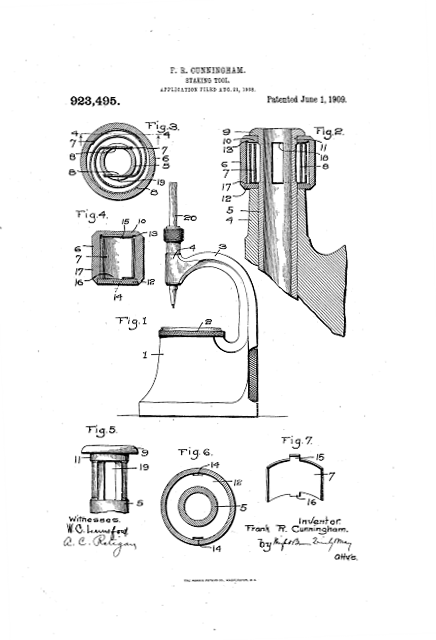
Of the accompanying drawings ,Figure 1 represents an elevation of a staking tool having my improvement applied thereto.

Fig. 2 represents a vertical section through the head of the staking tool and the attachment. Fig. 3 represents a horizontal section of the staking tool head and of the attachment constituting my invention. Fig. 4 represents a sectional view taken on line 44 of Fig. 3. Fig. 5 represents an elevation of the upper part of the tube which is set into the head of the staking tool and upon which the attachment constituting my invention is mounted. Fig. 6 represents a plan view of the bottom of the clamp holder forming part of my invention. Fig. 7 represents a perspective view of one end of one of the spring clamps.

The same reference characters indicate the same parts in all the figures.

A staking tool is shown in Fig. 1. and consists as usual of the base 1 having a die plate 2 and a curved neck 3 with a head 4 which overhangs the die plate. This head, as appears most clearly in Fig. 2, is bored vertically, and contains a tube 5 having along latitudinal bore or passage through which the punch centering member or other operating tool used in connection with a staking tool, is passed. My invention has to do entirely with a device by which the operating tool may be retained against displacement through the passage by gravity, while permitting such ,tool to be moved by the application of a slightly greater force, and with the means by which the device may be rendered inoperative by a single slight movement.

 The device constituting the invention consists of a clamp holder 6 in the form of a sleeve, and spring clamps 7 and 8 contained in such sleeve. The sleeve is journaled upon a portion of the tube 5 which projects above the head 4 and is contained between the upper end of this head and a flange 9 on the tube. The clamps are in the form of spirally curved flat springs which are contained within the sleeve 6, the interior diameter of which is sufficiently greater than the tube 9 to contain the springs and permit flexibility.

At or near the upper end of the clamp holder is an internal flange 10, the annular surface of which. fits an upper bearing surface 11 of the tube 5, while the other end of the sleeve is recessed to receive an annular plate 12. In the angle between the side walls and flange of the sleeve is a groove 13, and in the plate 12 near its periphery are notches 14. This groove and these notches are provided to receive lugs 15 and 16 on opposite sides near the outer ends of the springs which form the clamps. In assembling the parts, these springs are placed in the clamp holder 6 with their outer ends lying against the cylindrical walls thereof and their lugs 15 entering the groove 13.

They are adjusted so that the lug 16 of each will enter one of the notches 14 of the plate 12, and the latter plate is then put in place. It is preferably made so that it will fit tightly into the end of the holder 6 and abut against shoulder 17 formed therein.

The inner ends of the springs are straight and parallel with each other, lying on opposite sides of the center of the clamp holder, and when not distorted, located at a distance from one another less than the diameter of the shank of an operating tool. .Then the clamp holder is mounted upon the hearing tube 5 the clamps lie on opposite sides of the latter. They are enabled to make contact with and grasp the shank of the operating tool by reason of the fact that the tube 5 is slabbed off on opposite sides to a depth sufficient to provide openings or slots 18 and 19 which communicate with the internal bore or passage, and are of sufficient length to admit the spring clamps.

When the clamp holder is in the position shown in Fig. 3, the clamps enter the openings 18 and 19 and bear against the shank of the operating tool, grasping the same with a yielding pressure, which is sufficient to hold the operating tool in any position which it may occupy and prevent it from slipping downward against the die plate.

In Fig 1 an operating tool is represented by the punch 20, this figure illustrating how the tool is held up by the spring clamps. Upon rotating the clamp holder 6 slightly in either direction, the ends of the springs which form the clamps abut against the sides of the tube 5 adjacent the openings, and are drawn outward by the wedging action of the same so as to be removed from contact with the tool shank. The operating tool is then free.

Thus the parts of the tube adjacent these openings, or, in other words, the walls of the openings, constitute abutments which, when the clamp holder is in one position, retain the springs out of engagement with the operating tool and, when the holder is in another position, allow the springs to press with a yielding frictional engagement against the tool.

I claim

1. A staking tool having a head provided with a passage through it for admitting an operating tool, a spring friction member supported on said head and arranged to bear normally with a yielding frictional pressure upon such tool, and means for disengaging said friction member from the operating tool.

2. A staking tool having a head provided with a passage through it for admitting an operating tool, a holder mounted movably with respect to said head, a spring friction member carried by said holder, and means constructed to hold said friction member out of contact with such operating tool when said holder is in one position, and to permit said member to bear with a yielding frictional pressure on the tool when the holder is in another position.

3. A staking tool having a head provided with a passage through it for admitting an operating tool, a holder mounted rotarily on said head, a spring carried by said holder and arranged to bear with a yielding frictional pressure against such operating tool, and an abutment located beside such passage in the path traversed by said spring when rotated, whereby rotation of said holder causes the spring to engage said abutment and to be withdrawn thereby from engagement with the operating tool.

4. In a staking tool, a head having a tubular bearing for an operating tool, a holder rotarily mounted on said head, springs carried by said holder arranged to enter slots in the sides of said tubular bearing and press yieldingly against the shank of such operating tool, and adapted to be withdrawn from contact with the tool when the holder is rotated.

5. In a staking tool, ahead, a tube set in said. head having a bore to receive an operating tool and having an opening in its side, a sleeve rotarily mounted on said tube, and a spring held in said sleeve with its end arranged tangentially of the shank of said operating tool, and located so as to enter such opening and press against said shank, being withdrawn from contact therewith when the sleeve is rotated.

6. A staking tool having a head provided with a passage through it for admitting an operating tool, a holder mounted movably with respect to said head, a spring friction device carried by said holder for holding such operating tool with a yielding pressure, and an abutment against which said friction device is brought by movement of said holder and by which said device is Withdrawn from engagement with the operating tool.

7. In a staking tool, a head having a passage to contain an operating tool and provided with a lateral opening affording access to the passage, a sleeve rotatably mounted on said head, and a spring carried by said sleeve arranged to enter said lateral opening and bear yieldingly on the shank of the operating tool to serve as a frictional retainer therefor, said spring being caused to Withdraw from said shank by bearing against an edge of the opening when the sleeve is rotated.
8. In a staking tool, an independent clamp holder, spring clamps carried thereby adapted to grasp the shank of an operating tool yieldingly, and provisions for causing said clamps to release the operating tool While said holder remains in connection with the staking tool.

9. In a staking tool, an independent clamp holder, spring clamps carried thereby adapted to grasp the shank of an operating tool yieldingly, and fixed abutments on the staking tool arranged so as to be engaged by said clamps, when the holder and clamps are moved out of grasping position, and thereby cause withdrawal of the clamps from said shank.

10. A staking tool having a head, a tube et into said head having a bore to receive an operating tool, a clamp holder journaled on a part of said tube, and spring clamps carried by said holder; the tube having openings communicating with its bore in the zone surrounded by the holder into which said clamps extend to grasp the shank of said operating tool when the holder is in one position and from which the clamps are retracted by abutting against the sides of the openings when the holder is turned into a different position.

11. In a staking tool, a clamp holder consisting of a sleeve having an internal flange near one end and an annular plate attached removably to the other end thereof, and spirally coiled springs held at their outer ends between said flange and plate, their inner ends being free and arranged to grasp between them the shank of an operating tool.

12. In a staking tool, a clamp holder connects ends being free and arranged to grasp resisting of a sleeve having an internal flange between them, the shank of an operating tool near one end and an annular plate attached.

In testimony whereof I have affixed my removably to the other end thereof,  said signature, in presence of two witnesses observing the plate having notches, and spirally coiled springs held at their outer ends between, said FRANK CUNNINGHAM’S flange and plate, each spring having a lug returning one of the notches of said plate and 
held thereby against displacement.

Witnesses:

 A. O. RATIGAN.
 C. F. BROWN,

CLASSIFICATIONS
Cooperative Classification G04D3/04
Posted on

K&D Kendrick and Davis Poising-calipers.

Publication number US984354 A
Publication type Grant
Publication date Feb 14, 1911
Filing date Oct 23, 1907
Priority date Oct 23, 1907
Inventors Frank R Cunningham
Original Assignee Kendrick & Davis
Referenced by (3), Classifications (1)
External Links: USPTOUSPTO AssignmentEspacenet

DESCRIPTION  (OCR text may contain errors)
F. R. CUNNINGHAM.
POISING GALIPBRS.
APPLICATION FILED 00123, 19o?.
Patented Feb. 14,1911.
ces es afm@ @au L e.
1u: Noam; grans ca, wArrmNcroN, n. c
UNITED PATENT OFFICE.
FRANK R. CUNNINGHAM, OF MEDFORD, MASSACHUSETTS, ASSIGNOR TO KENDRICK 6c DAVIS, OF LEBANON, NEW HAMPSHIRE, A FIRM.

. ,.1 POISING-CALIPERS.
Application filed October 23, 1907.
To. all whom it may concern:
Be it known that l, FRANK R. CUNNING- HAM, of Medt’ord, in the county oi’ Middlesex and State o’t Massachusetts, have invented certain new and useful Improvements in Poising-Calipers, o’tl which the following is a specification.
The present invention consists in a tool for holding balance wheels oi’ watch or clock movements while being poised.
The objects are to provide a tool of this character permitting more rapid insertion and removal of work than in the poising tools heretol’ore used, lto permit an accurate adjustment ot’ the bearings tor the stattl ot’ ay balance wheel, to hold the same without looseness and also without end pressure, to provide a novel form of jewel bearing t’or the ends et’ a statt constructed with two jewels made separable so that they may be cleaned, and to provide other improved details oit’ construction which will be hereinafter more particularly described.
Of the accompanying cliavings,-Figiii’e 1 represents an elevation ot a tool embodying the principles of my invention. Fig. Q represents a sectional view of the same on an enlarged scale. Fig. 3 represents a crosssection on .line 3—3 ot Fig. 2. lF it represents an enlarged section through the bearings, illustrating in detail the construction thereof.
The same reference characters indicate the same parts in all the figures.
The instrument consists ot’ a frame 1 carried by a handle 2, and having arms 3 and 4l. These arms are separated somewhat and are absolutely rigid. having no relative movement of approach or recession whatever. In one of the arms, as. 4, is set a pin 5 passing entirely through the arm and having a threaded shank G on the inner side of the arm, to which shank is attached a stationary bearing 7. On the other arm is a tubular guide 8 in which is slidably contained a bar 9 carrying a movable bearing l0. The pin 5, bar 9 and bearings are all in line, and the movable bearing reciprocates on this line toward and from the fixed bearing. For so moving the bearing 10, l. provide an actuating lever 11 contained in a slot 12 in the arm 3, and pivoted upon a pin 18 in the caliper loody at the base of this arm. Connec- Speeieaton of Letters Patent.
Patented Feb. 14, 1911.
serial No. 398,760.
tion is made between the lever and slide 9 by means ota pin t-‘lon the latter, and resilient lingers l5 ,ttt on the end ot’ the lever. These fingers are separated by a slot 1G which, when the lever is free of the pin. is ot less width than the diameter et’ the latter. Consequently the insertion of the pin into this slot spreads the lingers apart somewhat, causing` them to embrace the pin and thus absolutely preventing any lost motion between they level.’ and slide.
ln the base ol” the caliper Yframe is formed a passage containing a plunger 17, a spring 1S pressing said plunger outward, and an abutment screw itt). The plunger bears against the lever 1l on the opposite side of its pivot ‘from the slide 9. and so tends to press the slide and the bearing carried thereby toward the fixed bearing 7. Threaded into the aliper -trame is a screw Q() which projects toward the lever 11 on the, opposite side o’t` the pivotV ,13 trom the sjn’ing-pressed plunger. This screw is in the path of the lever and serves as a stop to limit the approach ot the niovable bearing toward the fixed one. By turning the outer end of the screw, its position can be altered, and the distance between the bearings when brought to restv` adjusted. ly means o’tE this adjustment, the bearings can be separated so as to remove all t’rietion-producing pressure from the ends ot the sta tll held between them, and at the same time retain the stati without looseness. AV spring Q1 bears against the stop screw and holds one side ot its threads in engagement with the eomplemental thread oi the socket, wherein it is contained, thereby taking up any looseness which there may be. This stop is designed to limit the approach ot the mo vable bearing 10 toward the tixed one, and to adjust the space between the bearings so exactly that the statil ot’ a wheel may be held between them without friction-causing pressure on its end, and also without too great looseness. The actuating lever causes the movable bearing to be advanced toward and withdrawn from the fixed bearing rapidly so that wheels may be inserted and removed with the greatest convenience, while the adjustable stop serves to tit’y the bearings tor staffs ot all sizes. The connection between the lever and slide consisting ot the pin 14 in the slot 16, allows the slide to move. rectilinearly, while the resilience of the spring fingers causes them to bear with the same pressure on each side of the pin and so eliminate lost motion. This result, elimination of looseness, is further forwarded by the spring-pressed plluiger 1T’, which normally presses the b arings together’ and tends to hold the lever in contact with the stop 20.
One of the important innirovements of my invention is the constuction of the bearings. These are provided with jewels against one of which the end of the statt bears, while the other surrounds the staff and holds it against sidewise movement, and are separable so that they may be easily cleaned and polished. The bearing ‘T consists of a main holder which has a base in the form of a nut, and is screwed upon the threaded end of the pin 5. n its tip this holder provided with a. socket in which is set an end-thrust bearing jewel 22 which has preferably a plane, or at least unrecessed, surface against. which the end of the balance wheel statt is adapted to bear. The holder’ 7 is threaded externallj7 and receives a screw cap Q4 constituting the holder for the second jewel 25 of the bearing. This jewel is annular, having a central hole through which projects the reduced pivot of the staff. The movable bearing l0 is essentially similar, consisting of the main holder to which the numeral l0 is applied, carrying the end bearing ewel 2Q, and being threaded to receive the cap 24k which holds the annular bearing jewel It differs from the other bearing, however. in this, that the main holder l0 is symmetrical withA respect to its ends, being threaded into a socket in the slide 9, and capable of being turned end for end. In its opposite end it carries a jewel 221 similar to the jewel 22, which can be put into use by simply reversing the holder l0 in the socket and applying the cap 2st to the other end. rlhis capability doubles the life of the bearing, permitting replacement of a defaced or unsuitable jewel without necessitating’ delay for repairs.
In using the instrument for poising a balance wheel, the staff of the latter is first set in the bearings and adjusted so that there will be no end shakeor friction. The weights of the screws which are set into the rim of the balance are then varied in the usual way until the center of gravity is eX- aetly in the axis of the staff. In order to determine if the wheel is perfectly poised, it is set. into rotation b v vibrating the ltool through rubbing upon a portion of it, thetool being held against the edge of a bench. T he rubbing is done by an instrument which has suflicieut friction to set the tool vibrating, thus causing the balance to be rotated. lf it is perfectly poised. it will continue rotating as long as the rubbing is kept up, but if not so poised, it will of course come to rest with its heaviest portion downward. It is for the purpose of it’urnishing a convenient member to take the rubbing without injury to the apparatus as a whole that l lprovide the detachable projecting pin After considerable use, the part of the apparatus which is rubbed upon will become worn a ‘ay, and if no provision were made for replacing the worn part, it would become unfit for use. lVhen, however, the pin 5 is worn away, no harm is done, because a new pin can readily be substituted.
l claim:-
1. fr poising caliper, comprising a pair of rigid arms, opposed bearings mounted on said arms, one of which bearings is movable in a guide on its respective arm, an actuating lever for the movable bearing having spring lingers. and a pin on said movable bearing grasped between said lingers, whereby the bearing is enabled to move rectilinearly and lost motion is prevented.
poising caliper, comprising a pair of rigid arms, opposed bearings mounted on said arms, one of which bearings is movable in a guide on its respective arm, an actuating lever for the movable bearing pivoted to the body of the caliper, a spring-pressed plunger bearing on said lever on one side of its pivot tending to move it so as to press the movable bearing toward the other, an adjustable stop threaded into the caliper bodjY on the other side of the lever pivot from said spring-pressed plunger so as to limit the approach of the lever and movable bearing toward the other, and a spring arranged to press the threads of said stop in one direction against its complemental engaging threads to take up looseness between them.
3. A poising caliper, including a frame, a socket supported thereby, a reversible holder adapted to have either end detachably inserted and held in said socket, end-thrust bearing jewels set in both ends of said holder, a. cap detachably fastened on the outer end of the holder, and an annular lateral-bearing jewel set in said cap.
Lt. A, poising caliper comprising av frame having an intermediate space to receive a balance wheel, a bearing rigidly secured to said frame at one side of said space for one of the pivots of the balance statt, a bearing for the other pivot of said staff mounted at the other side of said space, with provisions for moving toward and from said fixed bearing. a` lever pivoted to the frame engaging said movable bearing and having a finger piece by which it may be engaged to retract the bearing, a spring-pressed pin mounted in said frame. and bearing` on said lever at one side of the pivot thereof to urge the movable hearing toward the fixed bearing, and an adjustable stop threaded into the frame in the path of said lever on the opposite side of the the movable bearing toward the fixed bezu’- secured to Suid ring approxmmtely conxiully ing. therewith.
5. A poising Caliper comprising u. frame ll CSHOHX WhCl’COf I 111W@ IIHXCCl my 5 and Separated bem-ings for the pivots 0f a s1g1mt1lre,1n presence of two Wltnesses.
b alance Staff Set upon said frame and rela- FRANK R CUNNINGHBL tlvely movable together and apart for admitpivot thereof for limiting the movement of 1 holder, und :111 annular lateral bearing jewel ting and holding such pivots, each bearing lftnesses: lneludmg a holder having an end thrust; ARTHUR H. BROWN,
10 jewel, :L ring detaohably threaded upon said l. NV. lmzzlc’r’rl.

Posted on

K&D Kendrick and Davis Micrometer screw-driver

Publication number US922080 A
Publication type Grant
Publication date May 18, 1909
Filing date Nov 4, 1907
Priority date Nov 4, 1907
Inventors
Original Assignee Kendrick & Davis
Referenced by (6), Classifications (3)
External Links: USPTOUSPTO AssignmentEspacenet

DESCRIPTION  (OCR text may contain errors)
G. W. BOWERS. MICROMETER SCREW DRIVER. APPLICATION FILED Nov. 4. 1907.
Patented May 18, 1909.
Inventor George W Bowers
UNITED STATES PATENT OFFICE.
GEORGE W. BOWERS, OF SOMERVILLE, MASSACHUSETTS, ASSIGNOR TO KENDRICK & DAVIS,
OF LEBANON, NEW HAMPSHIRE, A FIRM.
Specification of Letters Patent.
Patented May 18, 1909.

Application led November 4, 1907. Serial No. 400,541.

To all whom it may concern:
Be it known that I, GEORGE W BOWERS, of Somerville, in the county of Middlesex and State of Massachusetts, have invented certain new and useful Improvements in Micrometer Screwdrivers, of which the following is a specification.

Specification.

This invention relates to screwdrivers and has for its object to enable fractions of a rotation of a screw-driver to be indicated and measured.

The principal application for which this tool is designed, is in connection with watch making, especially during the adjustment of the balance wheel. Most watch balances are provided with mean time screws, sometimes called simply timing screws, which are used to bring’ the watch approximately to the time when the regulator is at the center of its arc. These screws, being in some cases two, and in others four in number, are threaded into the rim of the balance approximately in line with the arms which connect the rim to the hub, and, when there are four, midway between such arms, and are given sufficient friction so that they will remain in any position with their heads clear of the rim. 

To make the watch run faster, the screws are turned inward, thereby reducing the moment of inertia of the balance, while to make it run slower, they are turned outward. The effect is analogous to the raising and lowering of a pendulum bob. To insure a uniform rate of oscillation of the balance in all positions of the watch, the balance must be perfectly poised. Unequal changing of the timing screws, subsequent to the poising of the balance wheel, is liable to destroy such poise unless diametrically opposite screws are turned precisely the same angle. It is primarily to enable the timing screws thus to be so turned that l have devised the present invention which have illustrated as applied to a watchmakers screwdriver, and having an index capable of measuring minute fractions of a rotation, and thereby still  distances through which the timing screws are advanced or retracted. By the use of the index, the diametrically opposite screws can be turned by exactly the same amount.

In the drawings, Figure l represents a sectional elevation of a watchmakers screwdriver embodying the principles of my invention. Fig. 2 represents an elevation of the lower part of the same, showing the micrometer. Fig. 3 is a longitudinal section showing the screw-driver blade reversed. Fig. 1 is a perspective of one of the elements of the screw-driver. Fig. 5 is a sectional plan on the line 5 5 of Fig. l. Fig. 6 is a sectional view showing a modification. Fig. 7 is a plan view of another’ modification. Fig. 8 is a longitudinal section of the parts shown in Fig. 7, the section being taken on the line 8-8 of said figure. Fig. 9 is a view showing the manner of use of the micrometer screw-driver.

The same numerals of reference indicate the same parts in all the figures.

The tool shown in the drawings has externally substantially the same form as the ordinary watchmakers or jewelers screwdriver, having the shank 1 and the button 2, which by endwise pressure may be applied, and the blade 3 detachable secured in the opposite end of the shank by means of chuck jaws 4l, and a tapered sleeve 5. The chuck jaws are connected with the shank 1 through the medium of the sleeve 6 which tits tightly over the end of the shank, and the end of a hub 7 on which the chuck jaws are formed. The sleeve 6 tits so tightly over the parts which it surrounds that they are securely held together and caused to rotate in unison. Surrounding the hub 7 between a disk or image 8 formed in the latter and a flange 9 on the sleeve 6, is a ring 10 which is loosely confined between the flanges 8 and 9 and is held stationary when the screwdriver is turned. This ring 10 has engraved upon it an index mark 11 which cooperates with a series of graduations 12 marked on the periphery of the disk 8, these marks constituting the cooperating or complemental indices by which fractions of a rotation of the screwdriver blade are indicated and measured. The ring or band 1() is held stationary by a ringer ring 13 which is adapted to surround the middle finger of the user’s hand, while the screw-driver is turned by his thumb and forefinger. The ends of the inner ring are snapped into a socket 14 which is swiveled upon a stud 15 secured in a stem 16 which projects from one side of the band 10. Thus the finger ring can be turned about three axes at right angles to each other, having universal motion with respect to the screwdriver.

The manner of use will be readily understood. The tool being held as shown in Fig. 9, the end of the blade is then inserted into the slot of the screw which is to be turned, and the index marks noted. The tool is then turned by the thumb and forefinger, while the band is held absolutely stationary, and at the end of the turning movement the number of graduations 12 which have passed the stationary mark 11 is noted. When the tool is used for setting the timing screws of a watch balance, both of the diametrically opposite screws are turned through precisely the same angle which is measured by the graduations 12. As shown in the drawings, the screwdriver blade is detachable from the body of the tool. It is formed upon a stem 17 of which the end opposite of the blade is slaved 0H to make a flat face. Rehearsals end passes through the bore of the hub 7, abuts against the shoulder 18 of the latter, as shown in Figs. 3 and e. This shoulder is formed owing to the fact that the bore at the upper end of the hub is of less diameter than at the lower end. Above the shoulder, the hub 7 is partly cut away leaving shoulders 19. When the stain 17 is rotated until it slabbed off side comes into the same plane with the shoulders 19, it can be slipped by into engagement with these shoulders, the end of the stem then lying in the open space indicated at 20. The shoulder 19 then prevent relative rotation between the body of the tool and the blade. Then not in use, the blade can be turned end for end being caused to enter a recess 21 in the shank of the tool as shown in Fig. 3, being thereby preserved from injury.

In the modification shown in Fig. 6, the band 10 is omitted and the button replaced by a fork 22 of which the shank 22 is freely rotatable in a sleeve 24, being headed over at the end to prevent it-withdrawal. The sleeve 24 is fitted tightly into the shank 1 of the tool and has a disk 25 lying beside a disk 26 secured to the fork. Release disks have complemental graduations which serve, instead of the disk 8 and band 10, to measure the rotation of the screw-driver.

In Figs. And S is shown a substitute for the finger ring 13. Instead of a divided ring, there here shows a partial fork 27, the arms of which are curved toward each other forming nearly a complete ring. A stem 2S on the ring has a ball 29 which is contained and has a universal movement within a socket 80. This Socket has an internally tapered and externally threaded sleeve 31 fitting on the tapered stud 161 which extends from the band 101. This threaded sleeve is split and is clamped upon the stud by a nut 52. v

It is to be understood that although I have  illustrated one embodiment of my invention and described one of the modes of its use, the invention is not limited to strict embodiment or such use, but may have many other forms and may be used in any relation where it would be necessary or desirable to measure the angles through which a screw-driver is rotated.

Claim 1. In combination with a screw driver, cooperating index devices, one of which is arranged to be rotated and the other held stationary by the hand of the user, graduated to indicate fractions of a rotation.
2.v A screw-driver having a rotary blade and a relatively stationary index for showing the angle through which the blade is turned.

3. A screw-driver, comprising a rotary blade, and a member constructed, arranged Y and mounted so as to be held stationary by the hand of the user while the blade is being turned by the fingers of the same hand, by reference to which the amount of rotation of the blade is indicated.

4. A screw-driver, comprising a rotary blade, a disk or barrel connected to rotate therewith and having an index, and a relatively stationary member having a complemental stationary index by reference to which the amount of rotation of the blade is indicated.

5. Screw-driver, comprising a shank, a blade connected to said shank, a disk having a series of graduation marks and attached to said shank so as to turn simultaneously therewith, and with the blade, and a member beside said disk mounted upon said shank with provisions whereby it may be held stationary by the user While the blade is turned, and being provided with a complemental index mark by which, with reference to the aforesaid graduation marks, the angular movements of the blade are measured.

6. A screw-driver having a blade for actuating a screw and relatively rotary and stationary indices capable of indicating fractions of a rotation of said blade and minute advancements or retractions of a screw driven thereby. 

7. A screw-driver having relatively rotary and stationary indices capable of indicating fractions of a rotation, whereby to measure minute amounts of advancement or retraction given by the driver to a screw.

8. A screw-driver comprising an index adapted to rotate simultaneously with its blade and a complemental index adapted to be held stationary while the blade is turned, whereby movements of the latter may be measured. y

9. A screw-driver comprising a shank, a blade and a hub, all connected to rotate hub and adapted to be held stationary and a disk or Harige on the hub beside said band, the disk and band having con’iplen’iental in- my Dixie marks for measuring the relative rotation thereof”.

l0. il rotatable screw-driver, a member mounted thereon with capability of relative rotation, and provisions whereby said member may be held stationary by a finger of the user While the screw-driver turned, the member and driver having complemental indices for measuring rotation.

ll. A rotatable screw-driver, a member mounted thereon with capability of relative l rotation, and a projection from, said member adapted to be engaged and held stationary by the user of the tool while the screw driver itself is turned, said member and an adjacent surface of the screw-driver bearing index marks.
l2. A rotatable screw-driver, a member l mounted thereon with capability of relative rotation, and a finger ring,` jointed to said member and adapted to be slipped over the finger of the user to hold the Said member stationary while the screw-driver is being turned.
In testimony whereof I have affixed my signature in the presence of two witnesses.

A. H. BROWN, C. F. BROWN.